
Columbia Released Mugshot Records
A booking photograph records a person's appearance during an agency booking. It stays tied to that arrest or custody event. Release from Columbia County Detention Facility does not erase the underlying inmate-incarceration file, and a photo can remain public unless an exemption, sealing order, expunction order, or other rule limits access. A current roster, by contrast, serves present-custody needs and may drop a name once the person leaves.
Florida public-record access under §119.07 supports a request for an existing booking image, subject to exemptions and redaction. It does not force an agency to create a gallery. It also does not make every image the same. A CCSO booking photo, FDC digitized offender photo, FDLE registry image, and press photo have different origins and should be labeled accurately.
Where Columbia Release Photos Appear
No official CCSO public 24-hour or 72-hour release-photo feed was verified. That absence changes the order of work. Start with the named records request for a county booking image. Use FDC for a state-prison offender photo. Use registry and notification images only within their stated scope. Commercial galleries and data-broker links are not a recommended or reliable source path.
| Channel | Has a photo? | How to access and interpret it |
|---|---|---|
| CCSO recent-release feed | No verified public feed | Do not substitute a current booking page or another county |
| CCSO Records | Yes, when public and retained | Request the named booking photograph with booking and release documents |
| CCSO News | Sometimes | Search official incident releases; coverage is episodic, not a jail archive |
| Sheriff mobile app | No inmate-photo feature advertised | The official listing describes news, tips, reports, and interaction |
| FDC release search | Yes | Search released or scheduled-release state inmates and open the detail |
| VINELink | Sometimes | A photo appears only when the reporting agency supplies it |
| FDLE registry | Yes for covered registrants | Use only for the legally limited registry population |
| BOP locator | No | The federal locator provides status and date data, not a mugshot |
| Local reporting | Sometimes | Treat an attributed image as case context, not a custody certificate |
For a released state inmate, the FDC Inmate Release Information Search accepts name or DC number and offers photo-display controls. The captured official screen shows those fields.
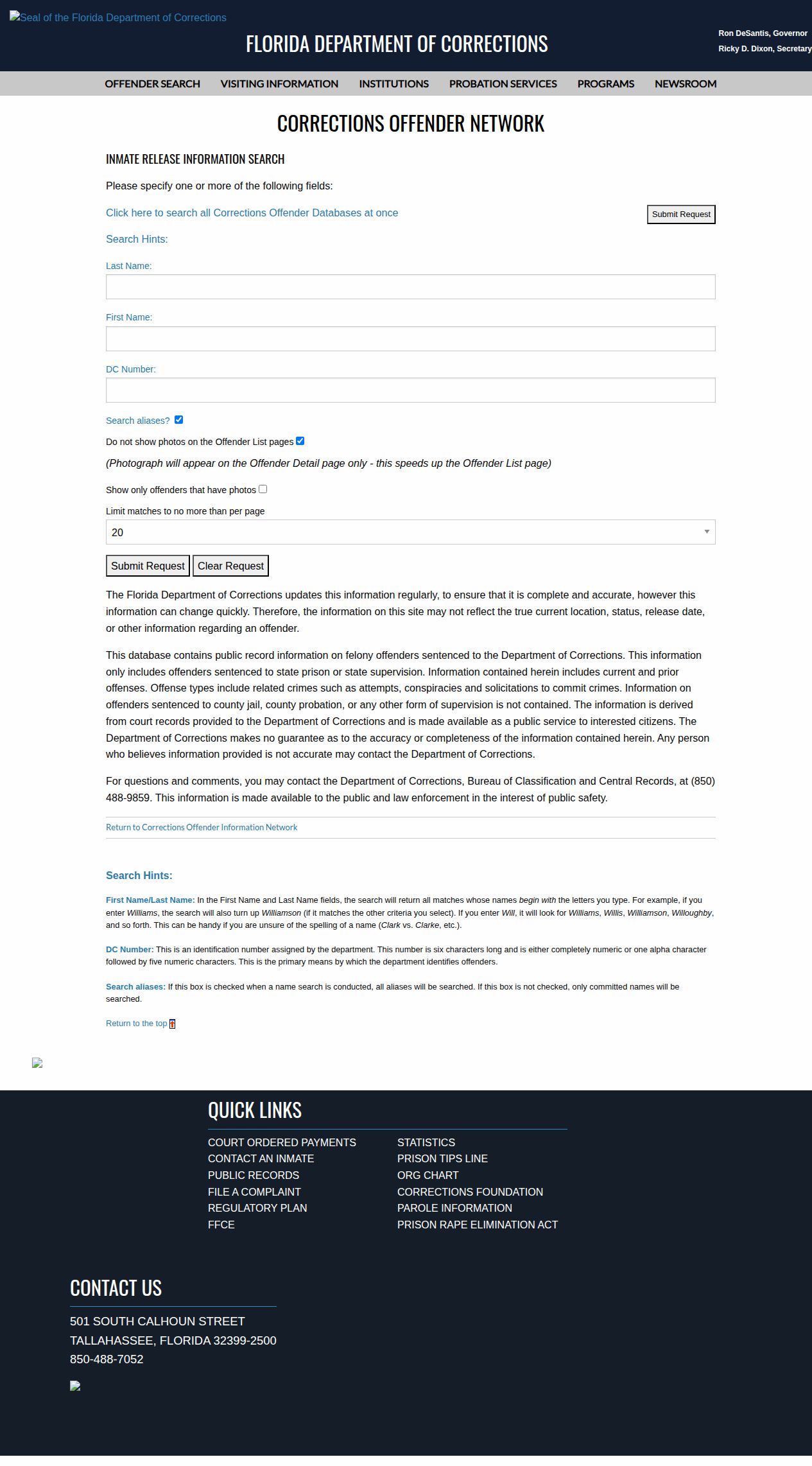
An FDC photo is an official state offender image. It is not necessarily the photograph taken during a Columbia County jail booking.
Columbia Sheriff Photo Channels
CCSO's public trail is episodic. The Sheriff News Room sometimes places a labeled booking photograph in an incident release, but it is not comprehensive and is not organized as a released-inmate gallery. Official Facebook, X, and Nextdoor accounts may repeat agency news. Social posts are also not release archives.
The official Columbia County Sheriff app listing advertises public-safety news, tips, reports, and agency interaction. It does not advertise an inmate lookup, release list, or booking-photo module. Do not assume the app exposes a photo that the website lacks. The absence of an advertised module is shown in the official app listing.
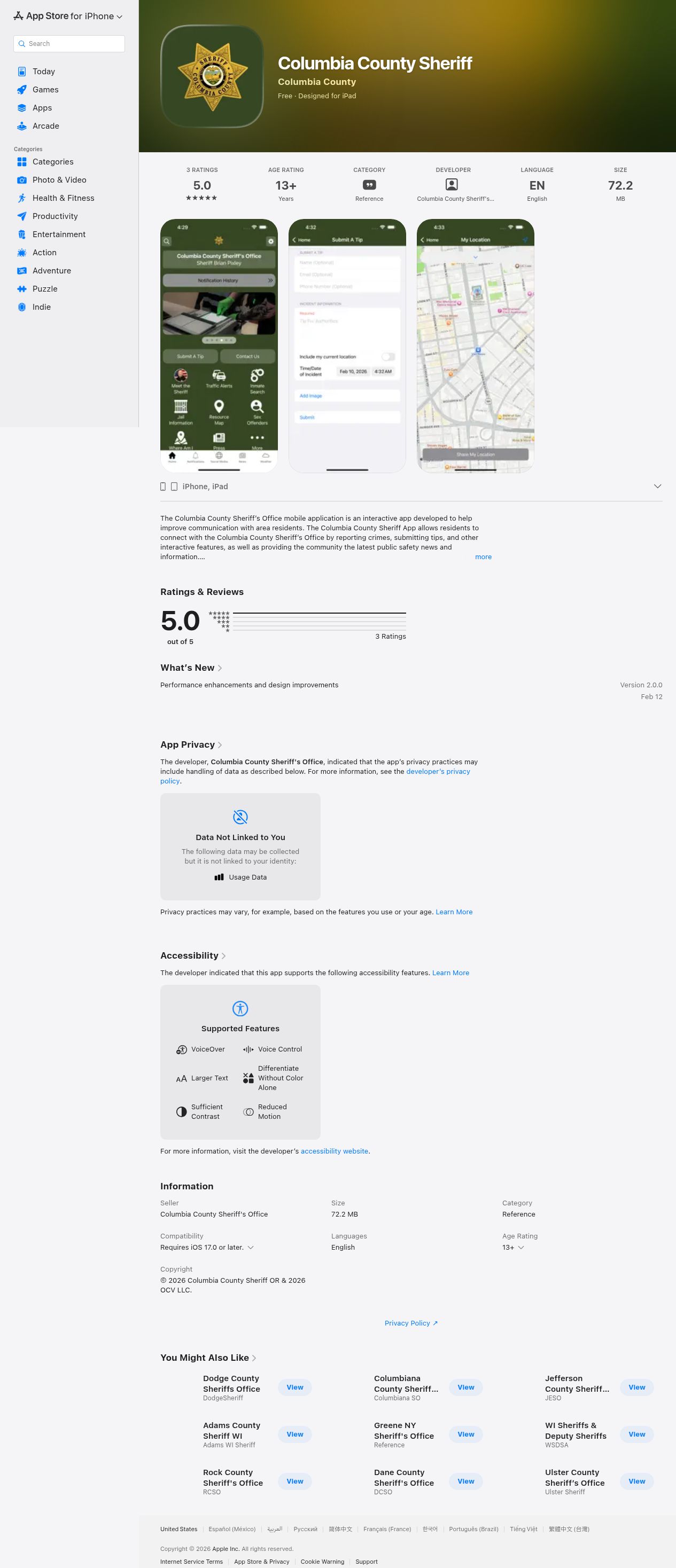
The listing supports a stable local rule: for a named county booking photo, use CCSO Records rather than hunting for an unverified app gallery.
The Columbia County 24-hour release list page explains why a narrow official-record request replaces a public rolling feed here.
Request Columbia County Booking Photos
CCSO accepts public-record requests in person, by phone, mail, or email. Ask for an existing image and identify the booking. A request framed as “all information” can be slow or unclear. A precise request also reduces the chance that Records treats it as a request only for an incident narrative.
- Gather the full booked name, date of birth if known, booking or case number, and approximate booking and release dates.
- Ask specifically for the booking photograph plus the booking and release documentation. State that electronic copies are preferred.
- Email ccso.records@columbiasheriff.org, call (386) 752-9212, or mail or visit Columbia County Sheriff's Office, 4917 U.S. Highway 90 East, Lake City, FL 32055, Attention: Records.
- If part is withheld, ask for the statutory exemption and release of the nonexempt remainder.
- Compare the returned image and identifiers with the release file or court case. Do not match on appearance alone.
The main-lobby service window operates Monday through Friday, 8:00 a.m. to 5:00 p.m. CCSO publishes charges of 15 cents for a single-sided page and 20 cents for a double-sided page after a qualifying first victim copy. Three or more reports, long research, or archive retrieval may add the employee's hourly research cost. No dedicated booking-photo fee was found.
Review the official CCSO request methods and fees with the captured records page.
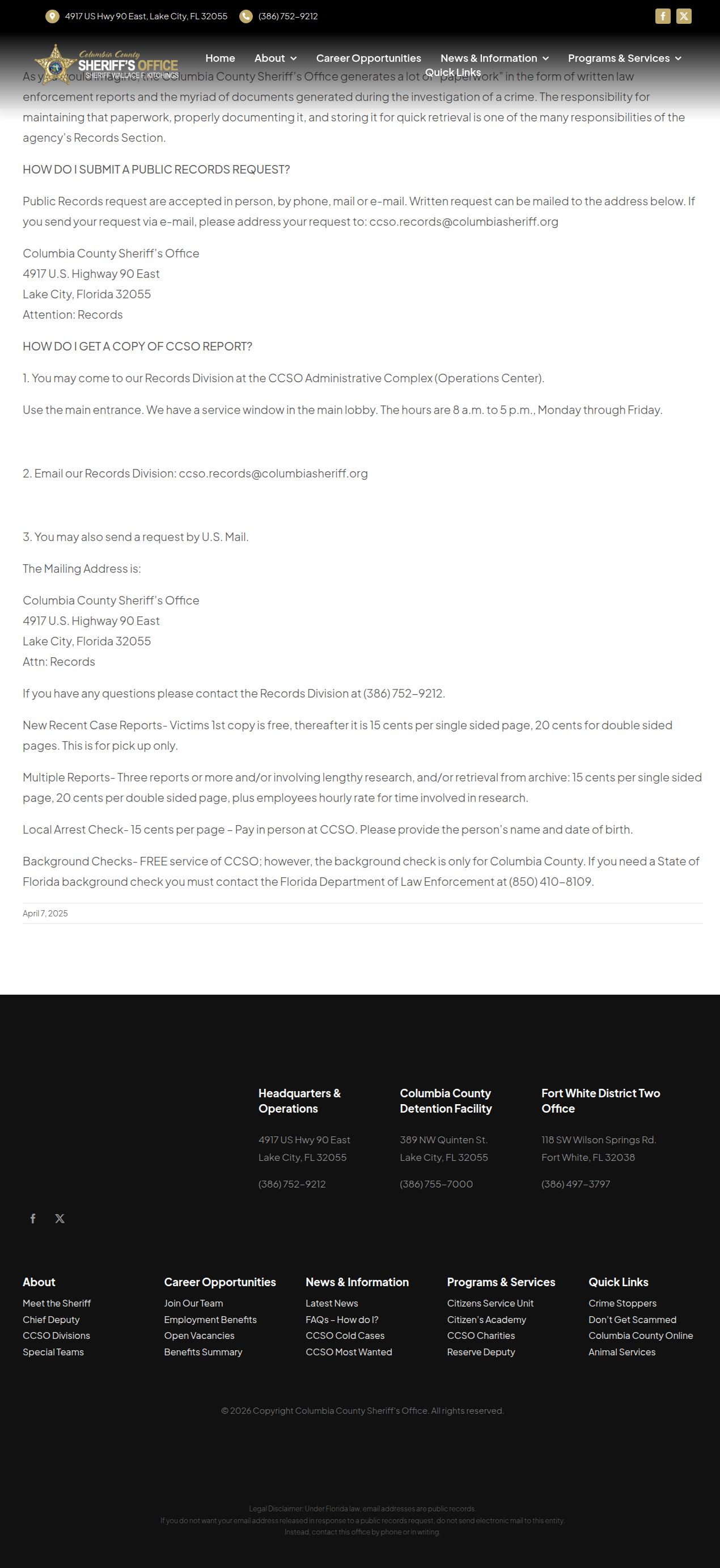
The official page confirms the email, mail, phone, and in-person options needed for a focused photo request.
Columbia News Images and Registries
Local reporting may carry an image when a Columbia County case draws coverage. Lake City Reporter, WCJB TV20, and News4JAX cover area cases. A directly attributed photo can provide context, but it should not be relabeled as a booking photo without the source saying so. A news image also cannot establish that the person is still in custody or was released.
FDLE's Sex Offender and Predator Search can show an identification image for a qualifying registrant. Its advanced status choices include “Released - Subject to Registration,” and Columbia is available as a county filter. This is legally narrow. No result does not say a person was never booked or released. The Career Offender Registry is also limited to its statutory class.
VINELink may display a photo when a participating reporting agency supplies one. A blank photo field is not a release fact. For federal custody, the BOP locator supplies no photo. An official DOJ, U.S. Attorney, or USMS release may show an attributed image, but it must be described by its true source.
Note: Commercial mugshot galleries can be stale, misidentified, or tied to a business model that Florida law directly regulates.
Columbia Mugshots and Expungement
Sealing and expunction change access only after the required legal process. They do not mean that release itself erased the booking. The Columbia County Clerk route starts after a person obtains an FDLE Certificate of Eligibility and then petitions the court. The certificate alone changes nothing.
FDLE calls for a notarized application, certified disposition, fingerprint card, a $75 processing fee, and other material tied to the requested relief. FDLE says certificate processing is usually about 12 weeks and is not expedited. The certificate expires after 12 months. The Clerk lists a $42 fee to enter a sealing or expungement order. Eligibility is restricted by law, so no outcome should be promised.
Read the local certificate-first and court-petition path before viewing the captured Clerk instructions.
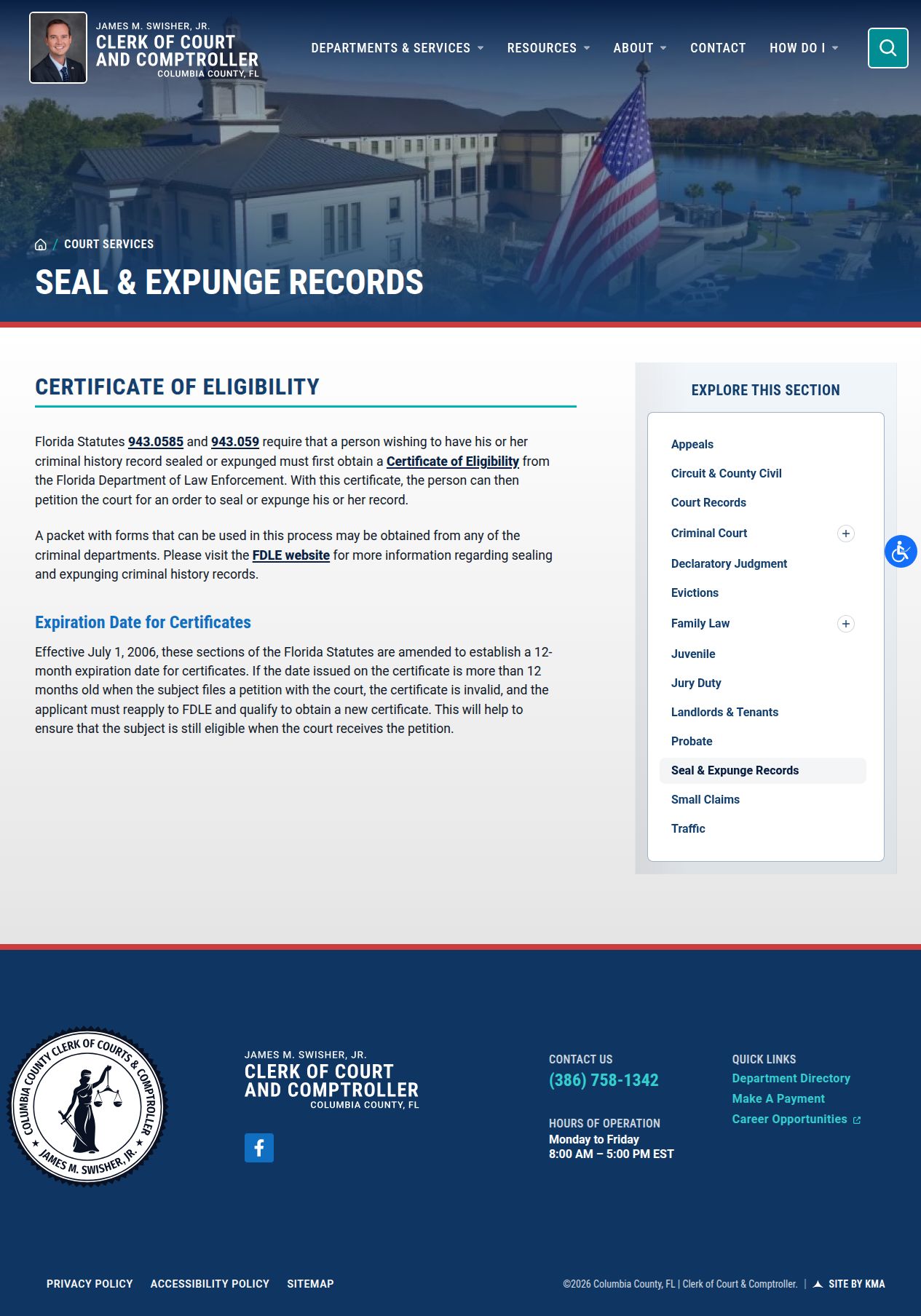
The local steps show why a court packet and certified order, not release alone, control later public access.
Florida's Free Mugshot Removal Rule
Florida Statute §901.43 targets covered commercial booking-photo publication models. A covered publisher may not solicit or accept payment to remove an arrest booking photograph. The subject or legal representative may send a registered-mail request to the publisher's registered agent with proof of identity and enough information to identify the image.
In covered circumstances, the publisher must remove the photo without charge within ten calendar days and may not republish or redisseminate it. The law allows injunctions, daily civil penalties, fees and costs, and treatment under unfair or deceptive practice law. This statutory route should be read directly. No paid removal service is endorsed or needed to understand the official process.
Review the official Florida booking-photo removal provisions with the captured statutory text.
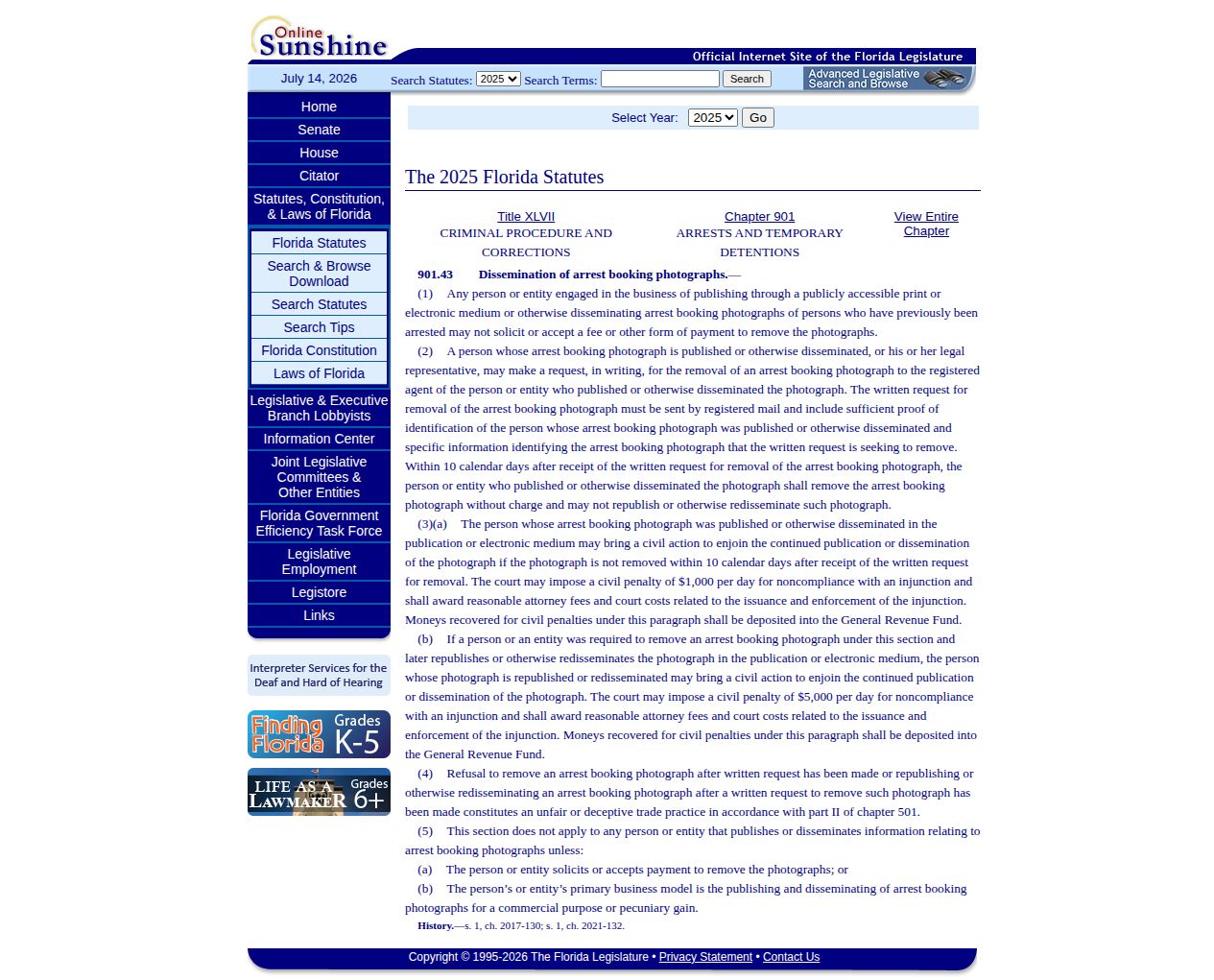
The statute is narrow. It does not order CCSO, FDC, or news archives to erase every lawful image.
Columbia State Offender Photos
FDC release information covers state inmates who were released or are scheduled for release, and the detail can show a photo even if list-photo display is off. Search by DC number when possible, then compare the name, birth data, offenses, and dates. FDC says the release database updates nightly. Questions about a release detail can go to the Bureau of Admission and Release at (850) 488-9167 or dc.release@fdc.myflorida.com.
Florida law also has a pre-release photo function. Section 944.605 requires a digitized photograph within 60 days before anticipated release and sharing of specified information and photos with law enforcement in covered cases. This helps explain why an FDC released-person record may carry an official image. It remains an FDC photo, not proof of what CCSO captured at an earlier county booking.
When an FDC public result is unclear, use the FDC Public Records Center and request the release or discharge record and digitized inmate photograph by name, date of birth, and DC number. The Columbia County released inmate record path helps identify whether CCSO or FDC is the correct custodian.
County and state retention also differ from web display. Florida's GS2 schedule treats booking cards, commitment papers, release documents, property receipts, transfer orders, and work-release papers as inmate-incarceration records. The record-copy minimum is one anniversary year after release once applicable audits have cleared. Jail docket books are permanent. Neither rule promises that a photo stays visible on a public website.
A focused request should therefore name the image and its parent booking record. Ask whether the photo remains in the inmate-incarceration file, whether part of the record is exempt, and whether a sealing or expunction order changed access. If CCSO no longer holds the requested copy, the court case can still identify the arrest and disposition, but the Clerk is not automatically the custodian of the jail's booking image.
Identity checks matter most when names are common. Compare the booked name, aliases, date of birth, booking or DC number, agency, and event dates. Photo resemblance alone is weak evidence. A current FDC image may also have been taken years after the Columbia County booking, so differences in age or appearance do not establish a mismatch without the record identifiers.