
Columbia Parole and Probation
A person can leave a Columbia County jail or Florida prison and still face legal control in the community. Probation is imposed by a court, often as a sentence or part of one. Parole is a discretionary release process that now applies mainly to old-law and other preserved eligibility groups. Most modern Florida prison sentences are not parole cases. Conditional release, community control, and addiction recovery supervision are also distinct legal forms, even though people may casually call all of them parole.
The first task is to read the exact supervision type in the FDC Supervised Population Information Search or the court order. Physical release and the end of supervision are separate events. Someone may be out of custody while an FDC termination date remains in the future. Another person may finish a sentence with no supervision at all.
| Record type | Who orders or manages it | What confirms it |
|---|---|---|
| Probation or community control | The sentencing court; FDC supervises qualifying state cases | Court order plus FDC supervision detail |
| Parole | Florida Commission on Offender Review | FCOR action and FDC supervision detail |
| Conditional release | FCOR and FDC | Release order, conditions, and supervision status |
| No supervision | Sentence or term has ended | Discharge or termination record, checked against the court file |
- Parole
- Discretionary release before sentence completion for a person who falls within Florida's limited parole-eligible groups.
- Probation
- Court-ordered community supervision that may follow custody or be imposed instead of confinement.
- Discharge
- The formal end of a custody or supervision term, not merely release from a building.
- Absconder
- A supervised person who stopped making himself or herself available to the supervising agency.
Verify Columbia Post-Release Supervision
Use custody-specific records. A Columbia County Detention Facility release file proves what the jail did, but it does not by itself establish the full probation or parole term. An FDC release result proves a state-prison release or scheduled release, while the supervised-population result addresses control in the community. A Clerk docket can show a probation order even when a person has no FDC prison history.
- Collect the person's full name and DC number, if known. A DC number is a stronger match than a name alone.
- Search the FDC supervised population database. Open the match and compare identity, supervision type, status, office, and termination date.
- Check the Columbia County court docket for the judgment, probation order, modification, violation filing, or termination. The online docket is unofficial and is usually refreshed with the prior day's entries.
- For a possible old-law parole or FCOR release, review the Commission's release type and hearing records. A scheduled hearing is not a release decision.
- Contact the office named in the supervision result. Do not assume Lake City Main owns the case solely because the person lives nearby.
The FDC record may list a supervision termination date. That is an expected or recorded end of supervision, not the day the person walked out of jail or prison. For the full release-search and agency reconciliation path, use the Columbia County released inmates search.
The official supervised-population screen shows the name and DC-number fields used to begin that match. Open the FDC supervision search before reviewing the captured form.
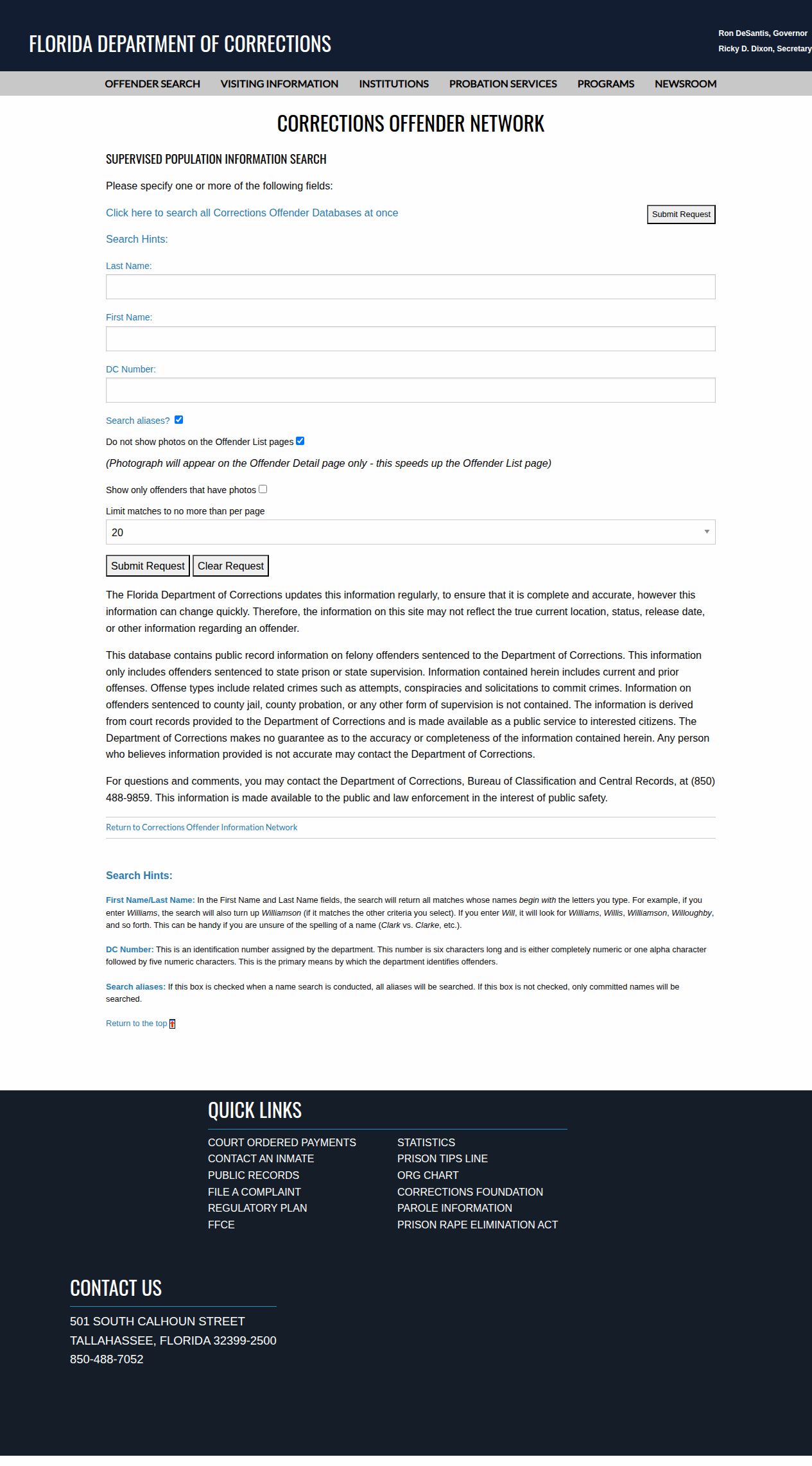
The form is limited to FDC community supervision. A Columbia County court case can still contain a probation order even when the person has no matching state-prison release record.
Columbia County Supervision Office
Columbia County is part of FDC Community Corrections Circuit 3, along with Dixie, Hamilton, Lafayette, Madison, Suwannee, and Taylor Counties. The official Lake City Circuit Office directory reported 2,319 people under Circuit 3 supervision on February 13, 2026. That number is a dated circuit-wide snapshot, not a live Columbia County total.
Lake City Circuit Office
1435 US Highway 90 West, Suite 120
Lake City, FL 32055
Circuit: (386) 362-2878
Fax: (386) 466-3011
Email: lakecity.cir@fdc.myflorida.com
030 - Lake City Main: (386) 754-1000
Fax: (386) 754-1002
Use the office shown on the named person's FDC record. A case can be assigned elsewhere within the circuit or state. The office can clarify reporting and record-routing questions, but the public search and court order remain the best starting points for identity and supervision type.
Columbia Supervision Types and Conditions
Conditions come from the court judgment, FCOR order, and supervision plan. They vary by release type. Conditional release is a mandatory post-prison mechanism for specified people and can be revoked after a willful and substantial violation. Conditional medical release is discretionary for qualifying people who are terminally ill or permanently incapacitated and assessed as not dangerous. Addiction recovery supervision applies only when its legal requirements are met. Control release remains a statutory category, though FCOR says it is not reviewing the prison population for new discretionary control releases while enough beds exist.
Read the named order. Do not infer a condition from a database label. A violation allegation also does not tell whether a warrant issued, a court found the violation, or supervision was revoked. Those steps appear in different records. VINELink may report a later custody change when a participating agency supplies it, but it is not a certified supervision order.
Note: A person can be released from physical custody and still remain subject to a valid supervision order or warrant.
Check Columbia Warrants and Absconders
Columbia County has a specific verification problem. The Sheriff's Office says its Warrants unit does not disclose warrant information to the public. Its Most Wanted page is selective, so absence there cannot rule out a warrant. The official local route sends users to the FDLE Florida Crime Information Center Public Access System.
Run a separate FDC Absconder/Fugitive Information Search when the issue concerns state supervision. An absconder is someone who ceased making himself or herself available to FDC. That status is not a successful discharge, and it is not the same record as a general warrant search.
The official FDC absconder screen shows the name and DC-number search route. Open and compare the record instead of relying on a list row.
View the official FDC absconder search before reviewing the captured search fields.
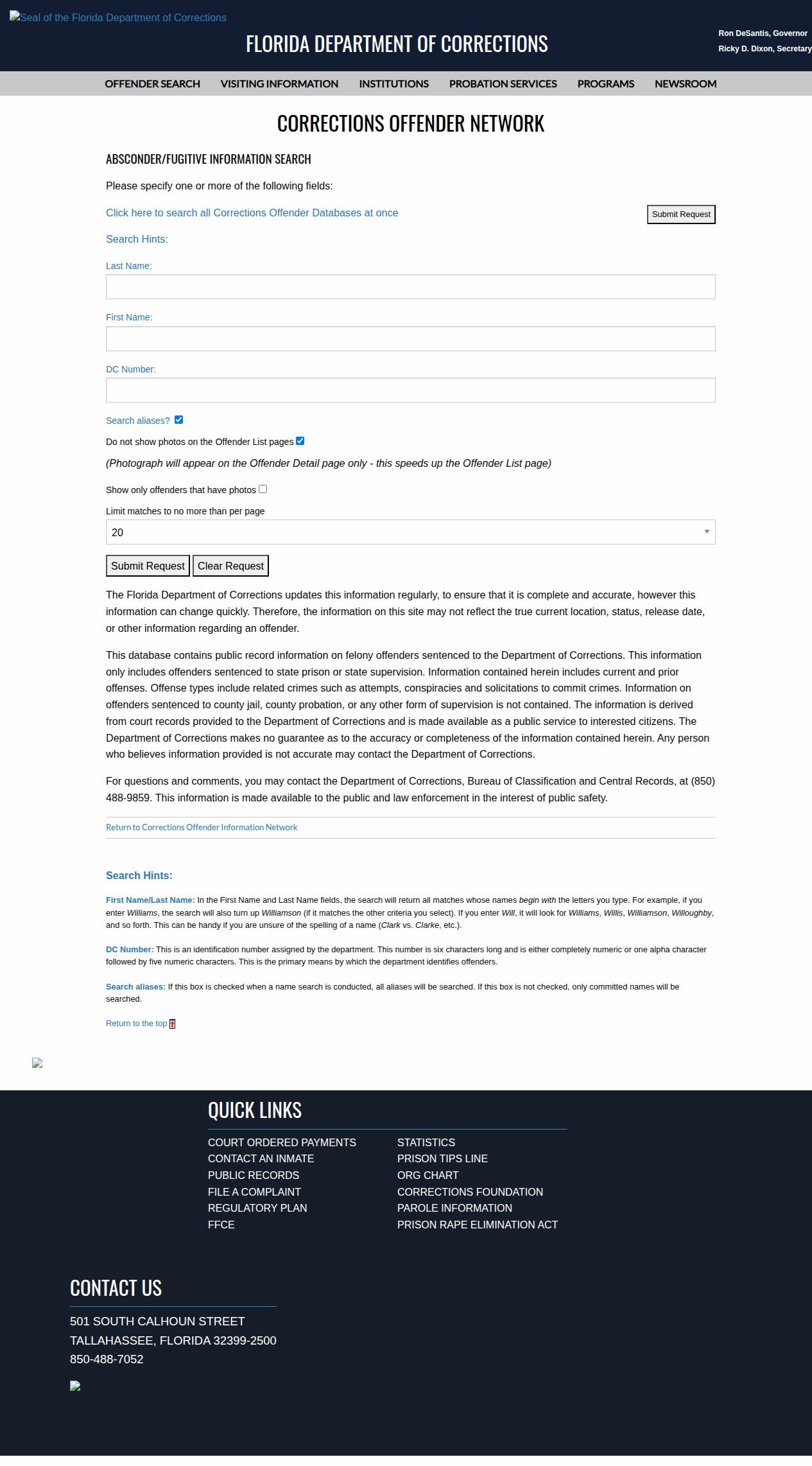
The screen supports the county-specific fallback chain: FDLE PAS for warrants, FDC Absconder for state supervision nonreporting, then the court and supervision files for context.
Property After Columbia County Release
Post-release needs do not start with the supervision office. Columbia County Detention Facility has precise property rules. A confined person may authorize a named family member or friend to collect property, but the authorization must already be in Main Control and the recipient must show identification. Authorized property must be collected within seven days of the form date.
A departing person may not leave property at the jail. Property left unclaimed for 30 days after departure is donated. The CCSO inmate-incarceration file may also contain a receipt for money or property returned at release. That receipt can help resolve what was handed back at the jail, while the FDC supervision record answers where and how the person must report.
CCSO also states that former inmates may not visit the jail for 30 days after release. That rule is separate from parole or probation terms. Check the official CCSO visiting and property information before arranging a pickup.
Columbia Parole Hearing Records
The Florida Commission on Offender Review publishes a rolling meetings and hearings calendar with dated vote, teleconference, and conditional-medical-release sessions. Detailed agendas may show a name, DC number, county, offense, case number, and scheduled category. An agenda is only a schedule. It does not prove that parole was granted, denied, deferred, or rescinded.
No official searchable FCOR decisions database was found. For a named final action, request the order or vote through the FCOR public-records channel, fcorlegal@fcor.state.fl.us, (850) 848-4460, or FCOR Public Records Request, 4070 Esplanade Way, Tallahassee, FL 32399-2450. FCOR says requests can be oral and anonymous, though charges may require prepayment.
Florida uses the terms presumptive parole release date and effective parole release date. An effective date can still depend on an approved plan and conditions. Eligibility is tied to offense and sentence dates, not simply age or time served. Section 947.16 sets interview rules, while FCOR explains the preserved eligibility groups.
Columbia Supervision Discharge Records
Supervision ends through the controlling order and agency process. The FDC supervised-population record can show the supervision type, status, assigned office, and termination date. The court docket may later show termination or satisfaction of probation. For parole and FCOR release types, the Commission's final action and FDC record should be read together.
A clean way to verify discharge is to match the same person by DC number, read the supervision status and termination field, then obtain the court or Commission order when the result matters. Do not treat a missing current-custody result as proof. A person may be discharged, transferred, listed under an alias, outside the system's scope, or affected by a data delay.
FDC's public OBIS data dictionary also identifies fields for supervision type, supervision status, supervising-office description, and termination date. Its monthly public data can help with older state records, but it is not as current as the live named search. Sealed, expunged, and confidential records are excluded. When the live result and a court entry appear to conflict, ask the agency that owns the disputed field to clarify or correct it.