
Columbia Projected Versus Actual Release
A projected date looks forward. An actual release record looks back at an event that occurred. FDC's current inmate detail uses the visible label Current Release Date. Florida Statute §944.275 calls the gain-time-adjusted projection a tentative release date, while the maximum sentence expiration date is the unshortened sentence calculation after lawful credit. These labels should not be merged.
For an active FDC inmate, a Current Release Date remains prospective. It may move. For someone shown in the FDC release database after discharge, a past release date is historical evidence. A Columbia County Detention Facility record uses a separate local computation and can show the physical release time, authority, and transfer destination.
A pretrial detainee does not have a sentence-based release date. Bond, a first-appearance ruling, dismissal, later court action, or another agency's hold can determine the result. Absence from a roster also proves little. It may reflect release, transfer, a spelling mismatch, or a data delay.
Find Columbia Projected Release Dates
Start with the last known custodian. The Columbia Correctional Institution complex, Lake City Correctional Facility, and Lake City Bridge Community Release Center all point to FDC records. The county detention facility points to CCSO Classification and the Columbia County Clerk. A move between FDC facilities or into a community release center is not final discharge.
- Identify the person by full name, date of birth, DC number, booking number, or case number. Prefer the agency identifier when available.
- For an FDC prisoner, open the FDC Offender Search menu and choose the current inmate population database. Read the detail's Current Release Date.
- Check the FDC Inmate Release Information Search to distinguish a scheduled or completed release from current custody. FDC says release information is updated nightly.
- For a Columbia County sentence, call the detention facility at (386) 755-7000 and ask for the date currently formulated from the judgment and credit. Give the booking and case numbers.
- Compare the jail answer with the Clerk criminal docket. Read the sentence, jail credit, concurrent or consecutive terms, and later orders.
- After the projected day, obtain the release record. The full Columbia County released inmate search path explains how to reconcile the custodian and court records.
The official FDC menu makes the database split visible. Open the FDC search menu before reviewing the captured interface.
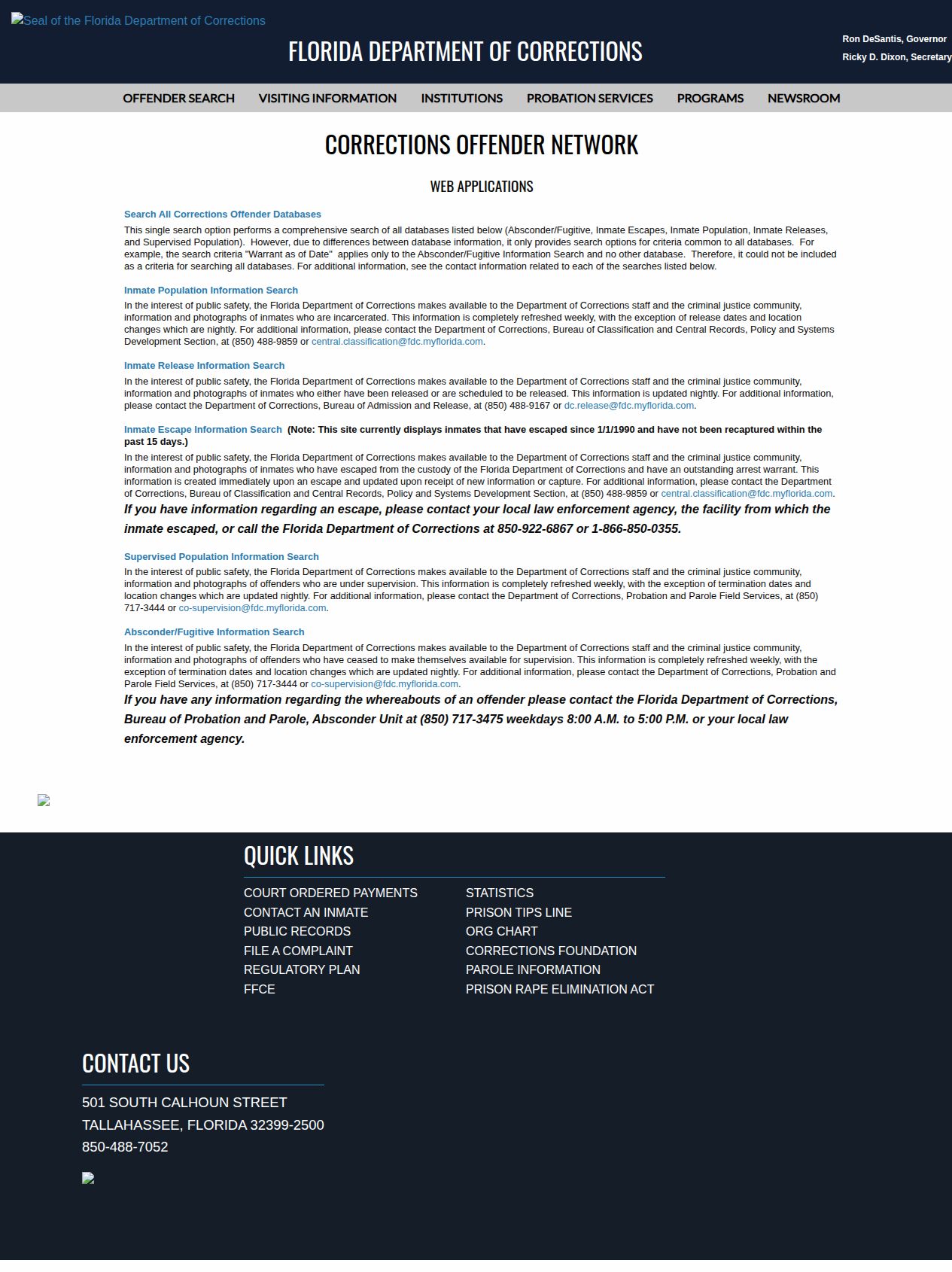
The separate population, release, supervision, and absconder options prevent a scheduled date from being mistaken for a completed release or community supervision.
Florida Gain Time for Columbia Releases
Under Florida Statute §944.275, FDC first establishes a maximum sentence expiration date from the sentence or combined sentences, less lawful credit. The tentative release date then reflects eligible gain time. Awards and restoration can move it earlier. Forfeiture can move it later. The tentative date cannot extend past the maximum expiration date.
Offense date controls the gain-time regime. Basic gain time of 10 days per month concerns offenses from July 1, 1978 through December 31, 1993. Incentive maxima include up to 20 days per month for offenses before January 1, 1994. For offenses from January 1, 1994 through September 30, 1995, the maximum was up to 25 days for former severity levels 1 through 7 and 20 days for levels 8 through 10. For offenses on or after October 1, 1995, eligible incentive gain time may reach 10 days per month, subject to exclusions.
Meritorious gain time may range from one to 60 days, and qualifying educational attainment can produce a one-time 60-day award. Serious-offense exclusions are date specific. Check the live statute instead of applying one list to every Columbia County case.
Read the official tentative-release and gain-time statute alongside the captured provisions.
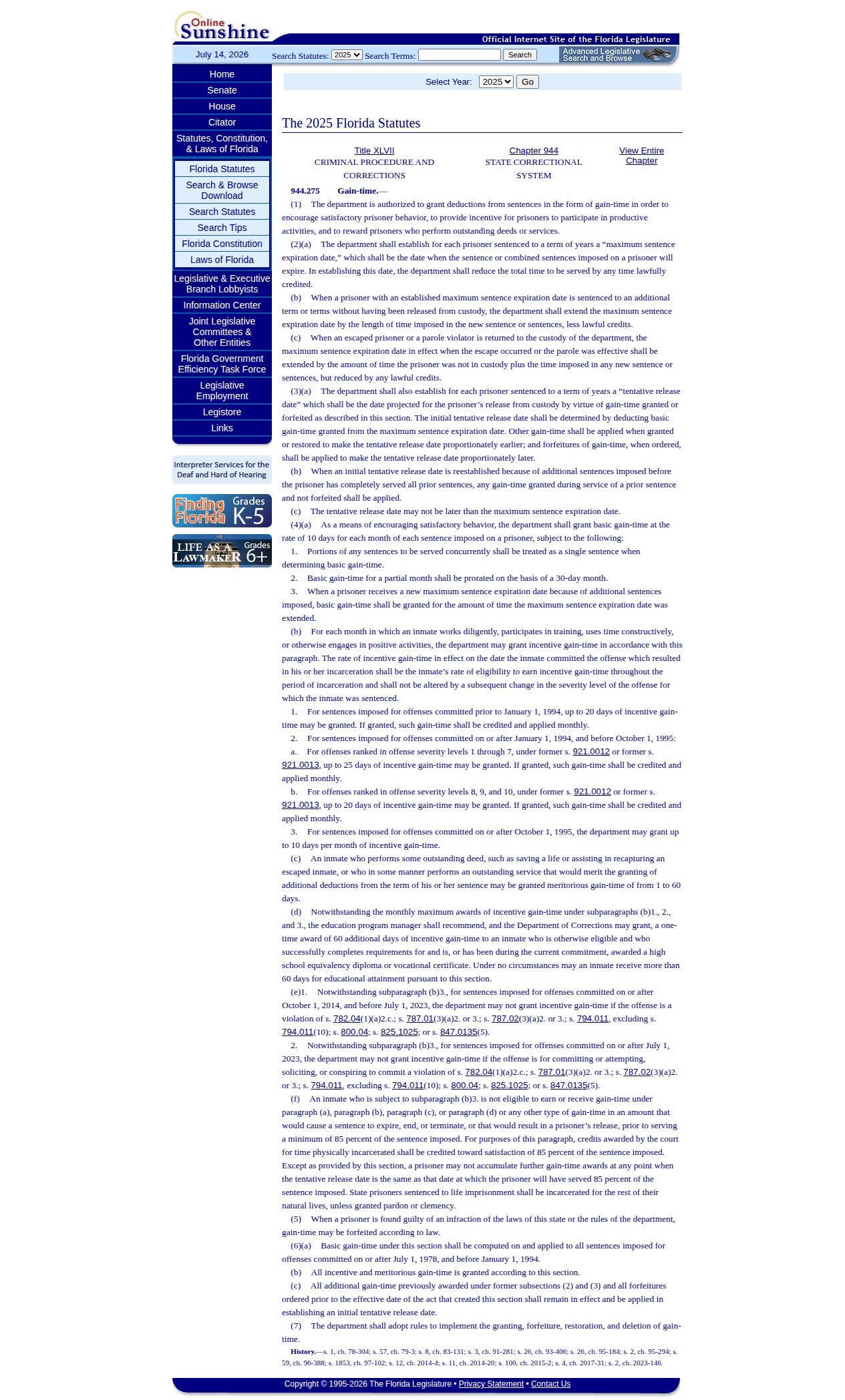
The statute supplies the legal terms and floor. FDC, not a private calculator, owns the official state date calculation.
Why Columbia Release Dates Change
A date can change because the inputs or legal authority change. FDC receives sentence and credit information, applies the correct offense-date rules, and updates gain time. CCSO Classification receives local court dispositions, tracks a county term, calculates local incentive gain time, and formulates its own date. Neither calculation should be recreated from a sentence length alone.
| Factor | Possible effect | Best record to check |
|---|---|---|
| Gain time awarded or restored | May move an eligible FDC tentative date earlier | FDC detail and §944.275 |
| Disciplinary forfeiture | May move the tentative date later | FDC calculation and inmate record |
| Corrected or new sentence | Can alter the maximum and tentative dates | Court judgment and FDC or CCSO record |
| Jail credit | Counts against the term when lawfully awarded | Judgment, commitment, and calculation |
| Concurrent or consecutive terms | Changes how combined sentences run | Court orders and agency calculation |
| Mandatory minimum or hold | Can prevent release on the date first expected | Sentence, detainer, and holding-agency record |
| FCOR release decision | May establish or change an eligible release path | Final FCOR action, not an agenda |
Detainer means a request or legal basis for another agency to take or keep custody. A transfer caused by a detainer ends one agency's custody but may not return the person to the community. This is why a CCSO departure line needs the release type and destination.
Columbia County's 85 Percent Rule
The common phrase "85 percent" is a floor, not a promise of release at exactly that point. For covered offenses committed on or after October 1, 1995, §944.275(4)(f) prevents gain-time release before service of 85 percent of the imposed term. Court credit for time physically incarcerated counts toward that floor. Further ordinary gain time cannot accrue once the tentative date reaches the 85-percent point.
Some people serve longer. Mandatory minimums, rules requiring full service, life terms, older offense regimes, forfeited gain time, and other sentences can all change the result. Section 921.002 also states that a Criminal Punishment Code prison sentence may be shortened only by authorized gain time and not below the 85-percent floor. It says chapter 947 parole does not apply to people sentenced under that Code.
Note: Serving 85 percent does not establish an automatic Columbia County release when another lawful term, minimum, or hold remains.
Columbia Jail Release Calculations
FDC's tentative-date rules do not directly calculate a Columbia County jail term. The Sheriff's Office says Classification receives court dispositions, tracks sentence length, calculates local incentive gain time, formulates correct release dates, and prepares FDC commitment packets. That workflow changes as court orders arrive.
Ask the jail for its current calculation using the full booked name, booking number, and case number. Then inspect the Clerk file for the sentence, credit for time served, and whether terms run together or one after another. A jail calculation may also be overtaken by a new hold or commitment. If the person is sent to FDC, switch to the state population and release searches. The county jail date is no longer the full custody trail.
Two Columbia Release Date Labels
Florida's exact labels create a common Columbia County error. FDC publicly displays “Current Release Date” on an active inmate detail. Section 944.275 calls the gain-time projection a “tentative release date.” Those terms refer to the state calculation from different sources, but neither is a completed release timestamp.
The distinction matters when a person is held at Columbia Correctional Institution, its Annex or Work Camp, Lake City Correctional Facility, or Lake City Bridge Community Release Center. A future date means the state currently projects release on that date. It does not show that the person has already left, cleared every hold, or entered the community. A Lake City Bridge placement is still an FDC community-release placement until the state record shows final discharge or supervision.
For a released person, switch to the FDC release database and open the matching detail. Then check the supervised-population database. The first can show the historical release event; the second can show whether post-release control applies. For a person transferred from Columbia County Detention Facility to FDC, the county release line only establishes the handoff from CCSO.
Note: A facility transfer may change location while leaving the sentence, projected date, and underlying state custody in place.
Columbia State Release Categories
Florida Statute §944.70 lists state release categories that include sentence expiration, expiration reduced by eligible gain time, clemency, conditional or conditional-medical release, and control release. The category helps explain what legal authority ended prison custody. It is not interchangeable with the date field.
Parole has its own limited, date-specific framework in Florida. A hearing agenda is a schedule, not a grant. A presumptive or effective parole release date may still depend on an approved plan and conditions, and FCOR can extend or delay action under the governing law. For that reason, a parole-related date should be checked against the Commission's final order and the FDC record, not inferred from a calendar entry.
County bond and pretrial release remain outside this state-prison sentence calculation. For those cases, the Clerk order explains the legal authority, while the CCSO release file supplies the actual time and destination.
Confirm Columbia County Release Dates
A projection should be checked again close to the date. For an FDC person, compare the current population detail with the release search and, if relevant, the supervised-population result. The official OBIS released-data publication is another historical fallback. It covers releases since October 1, 1997 and is generally refreshed monthly around the first, but excludes confidential and sealed or expunged data.
VINELink can provide a status-change alert when the reporting agency offers it. Register on the correct person's record and treat any alert as a prompt to verify. The Columbia County VINELink check explains registration. VINE does not replace the jail release file, FDC discharge detail, or court order.
For an ambiguous state date, the FDC Bureau of Admission and Release is available at (850) 488-9167 or dc.release@fdc.myflorida.com. For the county jail, call (386) 755-7000. Ask whether the response is a current projection, a scheduled release, a transfer date, or a completed community release.
Keep a record of the date checked and the exact label displayed. FDC's nightly release update and monthly OBIS publication have different refresh cycles, while the Columbia Clerk says its online court data is generally updated with the prior day's entries. A short lag across those systems does not prove an error. Recheck the matching agency record and request an official copy when the timing must be established.