
Columbia County Release Records
A Columbia County release means that one agency ended its custody. It does not always mean the person walked into the community. The Columbia County Sheriff's Office Detention Facility may release someone on bond, after time served, or under a court order. It may also transfer that person to the Florida Department of Corrections, another county, the U.S. Marshals Service, or immigration custody. The release type and destination decide which record should be checked next.
Booking staff process admission and release at the Columbia County Detention Facility. Classification receives court dispositions, tracks jail sentences, calculates local incentive gain time, prepares release documents, and assembles Florida prison commitment packets. Once a former detainee disappears from a current-custody display, the CCSO incarceration file and Columbia County Clerk docket become the durable local trail. A state prisoner follows the FDC release and supervision databases. A federal or immigration transfer requires the matching federal locator.
- Discharge
- The end of a sentence or custody term under the controlling agency.
- Time served
- Release after the court credits enough time already spent in custody.
- Parole
- Discretionary supervised release that mainly applies to preserved Florida eligibility groups.
- Probation
- Court-ordered supervision in the community, sometimes imposed without a prison term.
- Detainer
- A request or hold that may send a person to another agency instead of the community.
Columbia County Release Types
The word “released” needs context. A bond or recognizance release ends physical detention while the criminal case continues. A dismissal, acquittal, sentence completion, or credit for time served can also produce release. Probation may begin after the jail term. Transfer closes CCSO custody but starts or continues custody elsewhere. A death ends custody but is not a community release.
| Release type | What it means | Next official source |
|---|---|---|
| Bond or recognizance | The person leaves jail while the case remains open. | CCSO release line and Clerk bond order |
| Time served or sentence complete | The local custodial term has ended. | CCSO record and judgment or sentence |
| Dismissal or court order | The court supplied legal authority for release. | Clerk disposition plus CCSO timestamp |
| FDC commitment or transfer | County custody ended, but another custody began. | FDC population and release searches |
| Federal or ICE handoff | A federal agency may now control the person. | BOP, ICE, court, or USMS record |
Was a transfer a release? It was a release from the Columbia County Detention Facility, but not proof of freedom. The destination field or transfer order must be followed to the receiving agency.
Fields in Columbia Release Records
A useful request identifies the person and asks what the jail actually did. Full booked names, aliases, approximate dates, date of birth when known, and a booking or case number reduce mistaken identity. Ask for a booking photograph separately. An incident report is not the same as the inmate incarceration and release file.
| Field | What it shows |
|---|---|
| Booked identity and number | Connects the person to the correct jail episode. |
| Booking date and time | Marks the start of local custody. |
| Release date and time | Shows when CCSO relinquished physical custody. |
| Release type or authority | Identifies bond, sentence completion, dismissal, order, or transfer. |
| Charge and case numbers | Connect the jail record to the Clerk docket. |
| Destination or receiving agency | Distinguishes community release from continued custody. |
| Property and money receipt | Documents items returned or handled at departure. |
Florida's GS2 records schedule treats booking cards, commitment papers, transfer orders, property receipts, and work-release papers as inmate incarceration records. Copies have a minimum retention of one anniversary year after release once applicable audits are released. Jail docket books are permanent. Those retention rules do not promise a public online archive.
Request Columbia County Release Records
CCSO Records accepts requests by email, phone, mail, or in person. Ask for an existing record, not a conclusion about whether someone is free. Florida law does not require staff to answer an analytical question or create a new record.
- Give the full booked name, date of birth if known, booking or case number, and a narrow date range.
- Request the inmate incarceration and release documentation, including release time, authority, destination, court order, and property receipt.
- Ask separately for the booking photograph. State that an electronic copy is preferred.
- Ask the custodian to release nonexempt parts and cite the legal basis for withheld material.
- Match the response to the Columbia Clerk court record.
4917 U.S. Highway 90 East
Lake City, FL 32055
(386) 752-9212
ccso.records@columbiasheriff.org
Monday through Friday, 8:00 a.m. to 5:00 p.m.
CCSO lists 15 cents for a single-sided page and 20 cents for a double-sided page. Lengthy research, archive retrieval, or three or more reports may add employee labor cost. Section 119.07 also allows a reasonable special-service charge for extensive work. A focused request keeps the search clear and may limit cost.
The official CCSO request page shown below confirms the available contact routes and published copy terms.
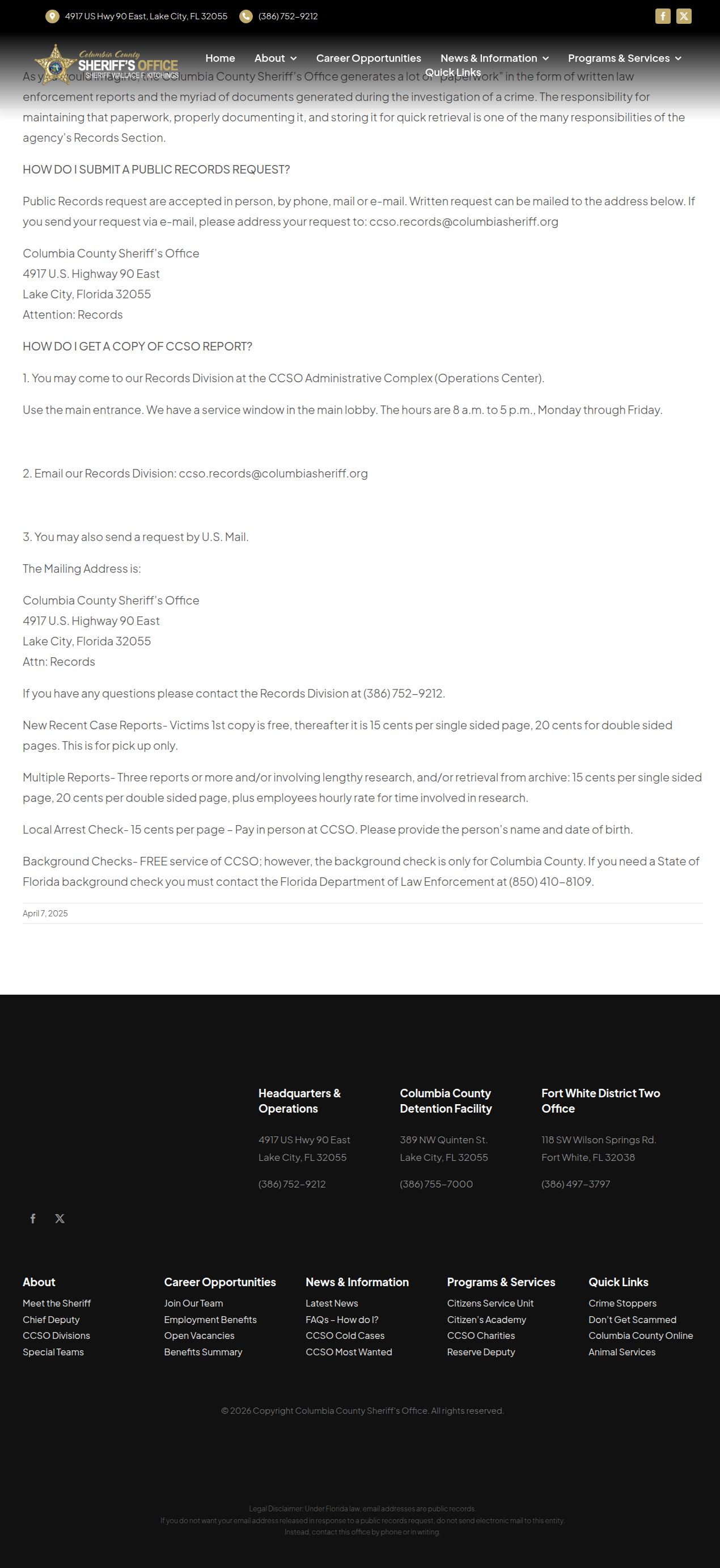
The image distinguishes the sheriff's records channel from the jail information line and the Clerk's court-copy process.
Florida Law on Columbia Releases
Florida Statute 119.07 requires prompt acknowledgement and a good-faith response. When an exemption applies, the custodian should redact the protected part, produce the rest, and cite the statutory basis. Juvenile records, medical material, victim information, sealed or expunged records, and safety-sensitive corrections data can be restricted.
A web roster window and the legal retention period are different. A name can disappear online while CCSO and the Clerk still retain responsive records.
Columbia Sealing and Release Records
Sealing and expunction change public access only after the required process. The Columbia Clerk route starts after an FDLE Certificate of Eligibility. FDLE says a certificate alone changes nothing, takes about 12 weeks in a typical case, and expires after 12 months. The Clerk lists a $42 entry fee for the order. Eligibility is limited, so no missing record should be treated as proof that relief was granted.
Columbia Bond Release Timing
Third Judicial Circuit Administrative Order 2026-001 supplies a current pre-first-appearance bond schedule for Columbia County. It applies only before the next scheduled first appearance, assigns a separate bond to each charge, and leaves the judge free to set a different amount. A listed amount is not a promise of release. Other charges, holds, payment processing, and a later order can change the result.
The current Third Circuit bond order shown below states its limited scope.
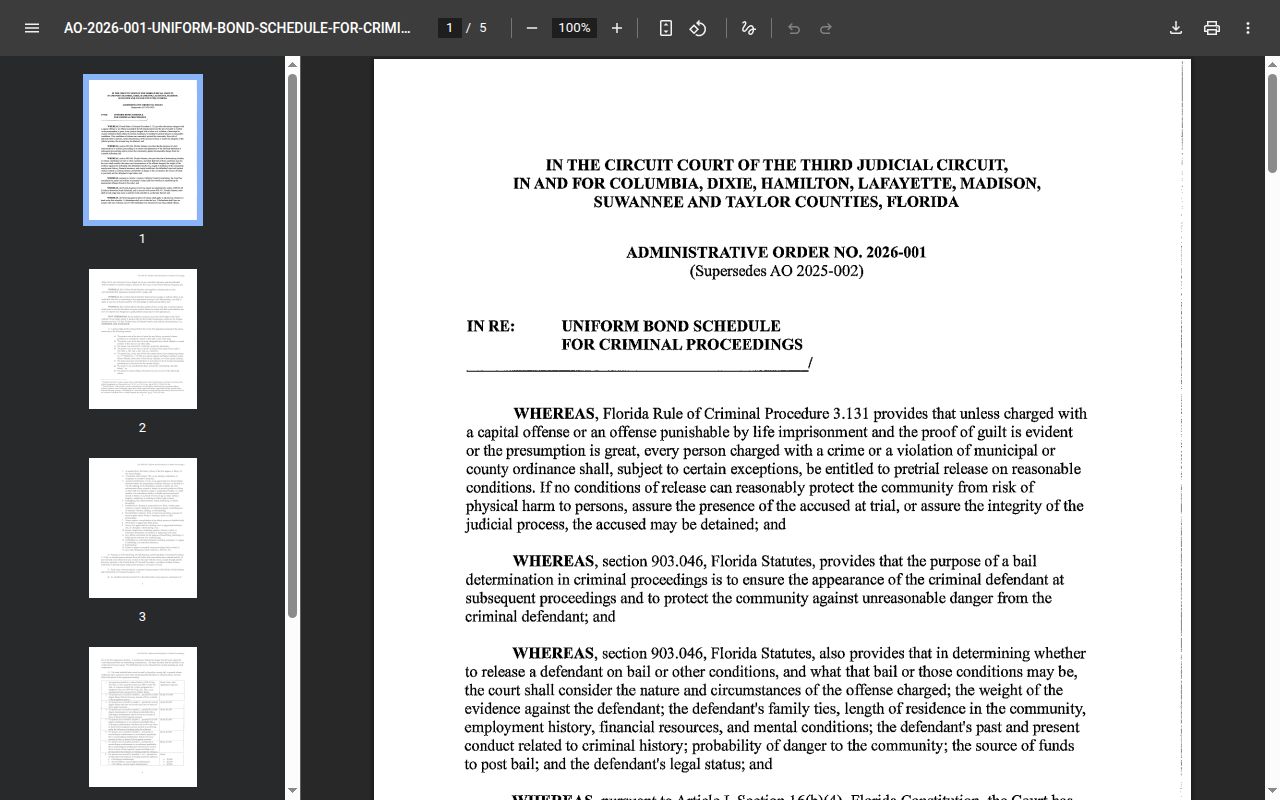
The order explains the legal path before first appearance, while the sheriff record proves whether and when release occurred.
Property After Columbia County Release
CCSO property rules continue through departure. A detained person may authorize a named family member or friend to collect property, but Main Control must already have authorization and the recipient must show identification. Pickup must occur within seven days of the form date. Property unclaimed for 30 days after departure is donated, and a departing person may not leave property behind.
The incarceration file may include the receipt for property or money returned at release. CCSO also states that former inmates may not visit for 30 days after release. No official public release hours, exit door, family waiting point, or guaranteed transit stop was found, so plans should be confirmed directly through the official jail property answer.
Columbia Courts and Release Orders
Columbia County's court split determines where legal authority appears. Circuit Court handles felonies. County Court handles misdemeanors and criminal traffic matters. Weekend first appearances take place at the jail. The anonymous Columbia criminal case portal can lead to bond orders, dispositions, judgments, sentence terms, jail credit, dismissals, probation, commitments, and later modifications.
The Clerk says online data is unofficial and usually refreshes by 7:00 a.m. with prior-day entries. It may lag. A docket order explains why release was authorized, but the CCSO record supplies the physical release time. Certified or official copies come from the Clerk. This two-record match is useful when someone left the roster before the newest court entry appeared.
Find Released Columbia County Inmates
Start with the last known custodian. A person leaving Quinten Street follows CCSO and Clerk records. Someone leaving Columbia Correctional Institution, its Annex or Work Camp, Lake City Correctional Facility, or Lake City Bridge follows FDC. A federal judgment points to BOP, while an immigration handoff points to ICE.
- Rule out continuing custody, but do not treat a missing roster name as proof of release.
- For a county-jail event, call the jail for immediate context and request the CCSO release file.
- Open the Columbia Clerk case and match the release authority, sentence, bond, or transfer order.
- For Florida prison custody, use FDC's dedicated release search and then its supervised-population search.
- Check VINELink for one specific person and set a future status alert when needed.
- Follow any transfer through BOP, ICE, USMS, another county, or the named receiving agency.
Released people normally drop from a current jail roster. Confirm release with the agency record and a court or supervision record, not absence alone.
The county does not publish a verified rolling list, so the Columbia County 24-hour release list process begins with a narrow records request. That feed-style request serves a different need from searching for one named person.
FDC Columbia Release Search
The Florida Department of Corrections search menu separates current inmate population, inmate release, supervised population, and absconder records. The population search answers whether someone remains in FDC custody. The release search covers people released or scheduled for release and refreshes nightly. Supervision and absconder searches answer different post-release questions.
| Search field | Use | Limit |
|---|---|---|
| DC number | Best identifier for an FDC record | Not a CCSO booking number |
| Last and first name | Finds likely state matches | Common names need identity checks |
| Alias option | Checks alternate recorded names | May broaden the result set |
| Photo controls | Help compare identity | A photo alone is not conclusive |
Open the result and compare the name, DC number, birth details, image, offenses, and dates. FDC's downloadable released-person data covers releases since October 1, 1997 and normally refreshes monthly. It can supply a deeper history when the public screen is not enough.
The official FDC release search shown here exposes the name, DC-number, alias, and photo controls.
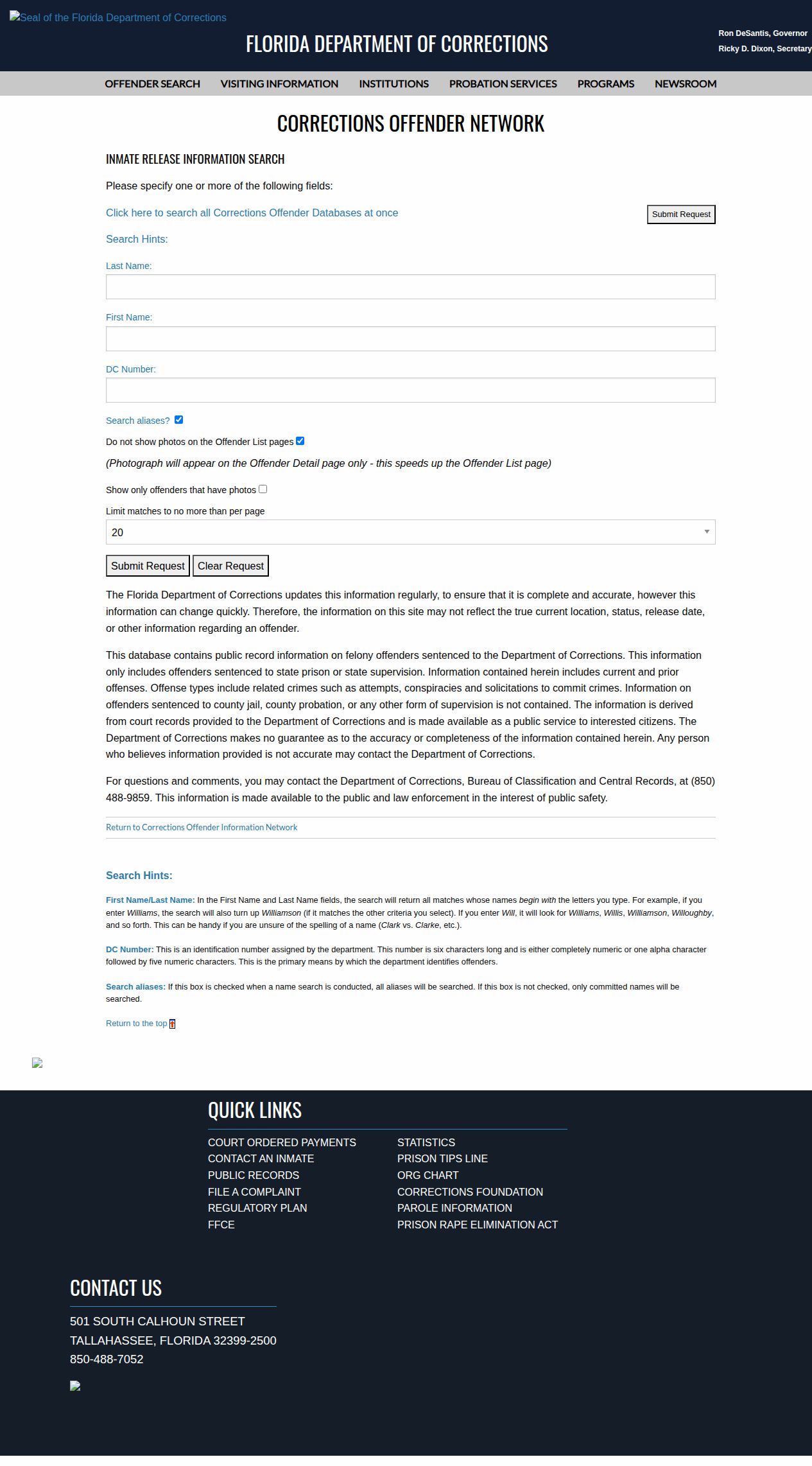
Those fields belong to the state-prison release trail, not to a county bond-out list.
Columbia County Recent Releases
CCSO does not publish a verified 24-hour release view, 72-hour view, or recent-release archive on its detention, FAQ, or indexed official pages. Its mobile app advertises news, tips, reports, and agency communication but not a jail roster or release module. Do not replace the missing feed with an arrest list, current-bookings page, unofficial mirror, or a sheriff site from another state.
Ask Records for releases within an exact start and end time. Request booked name, booking number, booking and release times, release type, case number, and receiving agency if public. Florida's GS2 schedule defines a 24-hour Commitment and Release List and retains that series for at least one anniversary year after release. The existence of a retained record does not require CCSO to display it online.
Columbia County Release Supervision
Physical release and the end of supervision are separate events. Use the FDC Supervised Population search for state probation, community control, conditional release, old-law parole, and other qualifying Florida supervision. Open the record and check its type, status, office, and expected termination date. If the facts suggest nonreporting, use the distinct FDC Absconder search. An absconder has stopped making themselves available for supervision; that is not a successful discharge.
Columbia County is served by FDC Community Corrections Circuit 3. The Lake City Circuit Office page lists the local office, but the assigned office in the person's record controls. The Columbia County parole and probation page explains the local verification chain and Florida release types.
Columbia Release Alerts and Transfers
Florida VINELink can search a specific person and register available phone, email, text, or app alerts from participating agencies. Select the reporting agency, match more than the name, and verify released wording with CCSO or FDC. VINE is not a certified release order and has no federal inmate data. A missed alert is not proof that no release occurred.
For federal custody, the BOP Inmate Locator covers federal records from 1982 forward. A released status or past date means BOP custody ended, not every other hold. ICE's locator is mainly for current adult immigration detention and can show “Not In Custody” for a limited recent period. That phrase may reflect removal, transfer, or release pending a case, so it does not prove return to Columbia County. USMS history may require a federal court record or focused request.
Columbia Custody or Release Search
Choose the source by custody level and question. Search systems do not substitute for each other.
| Question | Correct source | What it proves |
|---|---|---|
| Still in Columbia County jail? | Jail information line | Current local custody only |
| Released from county jail? | CCSO incarceration and release file | Time, type, authority, and destination |
| Why did release occur? | Columbia Clerk criminal docket | Court order, bond, disposition, or sentence |
| Released from Florida prison? | FDC Inmate Release Information | State release or scheduled-release record |
| On state supervision? | FDC Supervised Population | Type, status, office, and termination field |
| Federal custody ended? | BOP locator | BOP status and date, not other custody |
Two-source reconciliation is strongest. A CCSO timestamp plus a Clerk order can show bond release. An FDC release detail plus a supervision detail can show release to community supervision. A missing name, unmatched photo, or stale screen remains an unresolved lead.
Columbia County Release Facilities
Columbia County has an unusually varied custody landscape. Its sheriff jail, FDC prison complex, private state prison, and contract community release center can all hold people under different authority. Movement among them is not automatic freedom. The operator and custody type determine the right release record.
- Columbia County Detention Facility uses the CCSO release file and Clerk docket.
- Columbia Correctional Institution uses statewide FDC release and supervision records.
- Columbia Correctional Institution Annex shares the FDC path; a unit transfer is not discharge.
- Columbia Work Camp remains state custody until an FDC release occurs.
- Lake City Correctional Facility is privately operated under FDC authority.
- Lake City Bridge Community Release Center is a community placement that can precede final discharge.
The sheriff jail has 340 beds. Lake City Correctional Facility had a 950-person design capacity in its cited audit. These figures describe different systems and must not be combined into one county-jail population. Facility identity comes first, followed by the matching release search.