
Detention Facility Release Paths
Columbia County Detention Facility is the sheriff-operated county jail for local arrests, pretrial detention, county sentences, and short-term custody while another agency's commitment is prepared. Booking handles admissions and releases. Classification receives court dispositions, keeps release documentation, tracks local sentence length, calculates incentive gain time, and prepares commitment packets for the Florida Department of Corrections. Those roles make the jail record the best source for the physical date and type of departure from Quinten Street.
A bond, recognizance order, sentence completion, credit for time served, dismissal, or other court order may result in return to the community. A transfer line has a different meaning. Movement to FDC, another county jail, the U.S. Marshals Service, or ICE ends CCSO custody while another custody may begin. A prepared FDC commitment packet is evidence of state transfer, not a Columbia County community release. The destination or transfer agency in the record is therefore as important as the time stamp.
Confirm Columbia County Jail Release
No verified official CCSO 24-hour or 72-hour released-inmate feed was found. A missing name on a current display is only a lead. It can reflect release, transfer, a spelling difference, delay, or the wrong agency. For immediate custody context, call the detention facility. For lasting proof, request the inmate incarceration and release file from CCSO Records and compare it with the Columbia County Clerk criminal docket.
The most reliable check follows a short custody trail:
- Call the jail with the full booked name and date of birth, if known, to ask whether CCSO still has custody.
- Ask CCSO Records for the booking number, release date and time, release type or authority, and transfer destination if public.
- Search the Clerk docket by party name or case number for the bond, sentence, dismissal, commitment, or later order.
- If the file names FDC or another agency, continue in that agency's locator instead of treating the CCSO departure as community release.
The broader Columbia County released-inmate search and records path explains how to reconcile county, state, court, and notification sources. Online Clerk data is unofficial and ordinarily updates with prior-day entries, so obtain an official copy when the precise order matters.
Detention Facility Release Records
Ask for an existing inmate-incarceration file, not an opinion about whether someone is free. A focused request identifies the full booked name, date of birth if known, booking or case number, and an approximate date range. Request the booking card, release documentation, court disposition received by Classification, transfer order, release property and money receipt, and booking photograph when needed. Medical, juvenile, victim-location, and other exempt material may be redacted while nonexempt parts are released.
CCSO Records
Columbia County Sheriff's Office
Attention: Records
4917 U.S. Highway 90 East
Lake City, FL 32055
Phone: (386) 752-9212
Email: ccso.records@columbiasheriff.org
Lobby: Monday through Friday, 8:00 a.m. to 5:00 p.m.
CCSO accepts requests in person, by telephone, mail, or email through its public-record request channels. Published report-copy rates are 15 cents for a single-sided page and 20 cents for a double-sided page. Lengthy research, archives, or three or more reports may add employee research cost. No special release-record fee was verified, so request an estimate when the scope may be large.
Columbia Release Orders and Dockets
The jail executes a release order but does not decide the criminal case. Columbia County's Clerk docket can show the bond order, dismissal, judgment, sentence, jail credit, probation, FDC commitment, warrant, hold, modification, or satisfaction that explains why the custody event occurred. Circuit Court handles felony matters. County Court handles misdemeanors and criminal traffic. That split helps route copy questions to the right criminal division.
Use the Columbia County court search by name or case number, then open the matching criminal case and read the dated entries. A court entry can establish legal authority, while the CCSO file supplies the actual physical release time. The Clerk cautions that the online view is not the official record and is generally refreshed by 7:00 a.m. with the prior day's entries.
First appearance also matters. CCSO says it occurs daily by Zoom, and a person who cannot bond is brought before a judge within the first 24 hours. A scheduled bond amount is not proof that bond was posted. The docket, jail release line, and any receipt must agree before a bond-out is treated as complete.
Note: Court authority and physical release answer different questions, so one record should not be used as a substitute for the other.
Columbia Detention Facility Details
The official CCSO detention facility page identifies a county jail built in 1987, with replacement detention space added in 2022. It reports 340 beds and minimum, medium, and maximum classifications. These are facility facts, not release totals. A one-time, nonrefundable $15 subsistence fee applies at each intake. That intake charge must not be described as a fee paid to secure release.
The official page also shows why Booking and Classification should not be collapsed into one function. Booking processes the exit. Classification interprets court dispositions, computes sentence dates, keeps the paperwork, and prepares state commitment material. When the two functions produce records for the same person, the documentation can show both the moment CCSO custody ended and the authority or destination that controlled what happened next.
The official facility source shown below displays the local booking, release, and Classification descriptions used to route a request.

The image supports the key distinction: local staff process a jail departure, while the release type and destination determine whether community release occurred.
Property After Columbia Jail Release
CCSO publishes unusually precise property rules that continue after someone leaves custody. A confined person may authorize release of property to a named family member or friend. The recipient must present identification, and the authorization must already be held in Main Control. Authorized property must be picked up within seven days of the form date. Property left unclaimed for 30 days after departure is donated, and a departing person may not leave property behind.
The release file may contain the receipt for money or property returned at departure. That receipt can help resolve a narrow question about what was released with the person, but it should not be treated as proof of the court outcome. The sheriff also states that former inmates may not visit for 30 days after release. This is a local visiting rule, not an extension of custody or supervision.
The CCSO property and visitation rules shown below document the authorization and pickup deadlines.
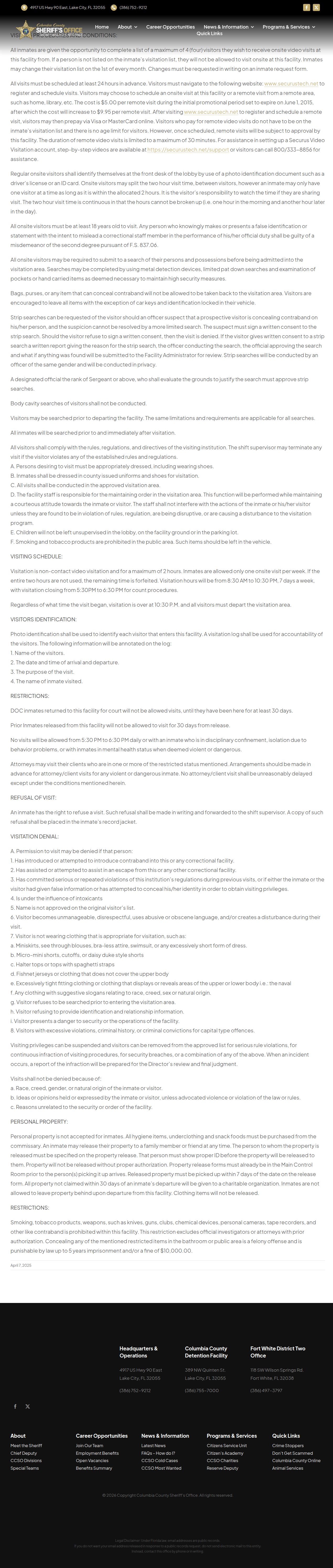
Planning the pickup early matters because the seven-day authorization period and the later disposal deadline are separate clocks.
Columbia Facility Release Differences
Columbia County contains a sheriff jail, the FDC Columbia prison complex, a privately operated state prison, and an FDC contract community release center. This mix is the county's most important custody distinction. A person can move between these settings without becoming free. Facility and operator identity determine the correct record source.
| Departure | What it may mean | Next source |
|---|---|---|
| Community release | Bond, court order, or county sentence completion | CCSO file and Clerk docket |
| FDC commitment | State custody continues after the jail exit | FDC population and release searches |
| Other agency transfer | Custody may continue in another jurisdiction | Named agency locator or record |
| No current CCSO result | Release, transfer, delay, or mismatch | Call and request the release line |
Florida's retention schedule keeps inmate-incarceration record copies for at least one anniversary year after release once applicable audits are released, while jail docket books are permanent. That does not require CCSO to post a web archive. It means a focused records request remains useful after a name disappears from a current view.
The same rule applies when CCSO records a federal or immigration handoff. A transfer line can prove that the person left Quinten Street, but it cannot prove freedom from the next agency. A federal sentence points to the BOP locator. An immigration transfer points to ICE's current-detainee locator and its limited recent not-in-custody result. A U.S. Marshals movement may require the federal court order or a focused federal records request. The destination named in the CCSO file selects the next search.
No federal prison or dedicated ICE detention center was verified in Columbia County. Those systems matter only when a county or court record documents another agency's role. A failed federal search must not be used to fill the gap with an assumption. Ask for the transfer agency and date, then verify that agency's custody outcome.