
Columbia County 72-Hour Release Access
No official Columbia County Sheriff's Office page offers a labeled 72-hour release table, a three-day released-inmate view, or a public update schedule. The official detention page describes the work of Booking and Classification but gives no scrolling release roster. An arrests list or current-bookings display cannot stand in for a release record, and a similarly named sheriff's office in another state is not a Columbia County, Florida source.
The strongest fallback is a request for the exact interval. Ask CCSO Records whether it can supply an existing Commitment and Release List or equivalent export for releases from Columbia County Detention Facility. The record name comes from Florida's retention schedule, not from a verified CCSO public product. Pair the list with the Clerk docket and direct jail status. VINELink can add a specific-person status check, while FDC records apply only after a state commitment or to a state-prison release.
Request Columbia County Three-Day Releases
Set the period with exact beginning and ending dates and times. “The last 72 hours” can shift while staff process the request, but a fixed interval does not. A concise request also gives Records a fair chance to find an existing list without creating a new report.
- Choose a fixed 72-hour interval and write both endpoints. If the event may have crossed a weekend, include the full span rather than three separate daily requests.
- Contact CCSO Records in person, by phone at (386) 752-9212, by mail, or at ccso.records@columbiasheriff.org.
- Ask for the existing release log, Commitment and Release List, or equivalent export for Columbia County Detention Facility. State that an existing record is requested.
- Request booked name, booking number, booking date, release date and time, release type or authority, charge or case number, bond, and transfer destination when public.
- For any named person, compare the result with the Columbia County Clerk case search and ask for an official court copy when accuracy has legal importance.
CCSO publishes copying charges of 15 cents for a single-sided page and 20 cents for a double-sided page. Extensive retrieval may bring labor charges. A narrow interval and clear field list may limit the search burden, but Records must assess the actual request.
The official CCSO records-request screen displays the Columbia County routes and terms:
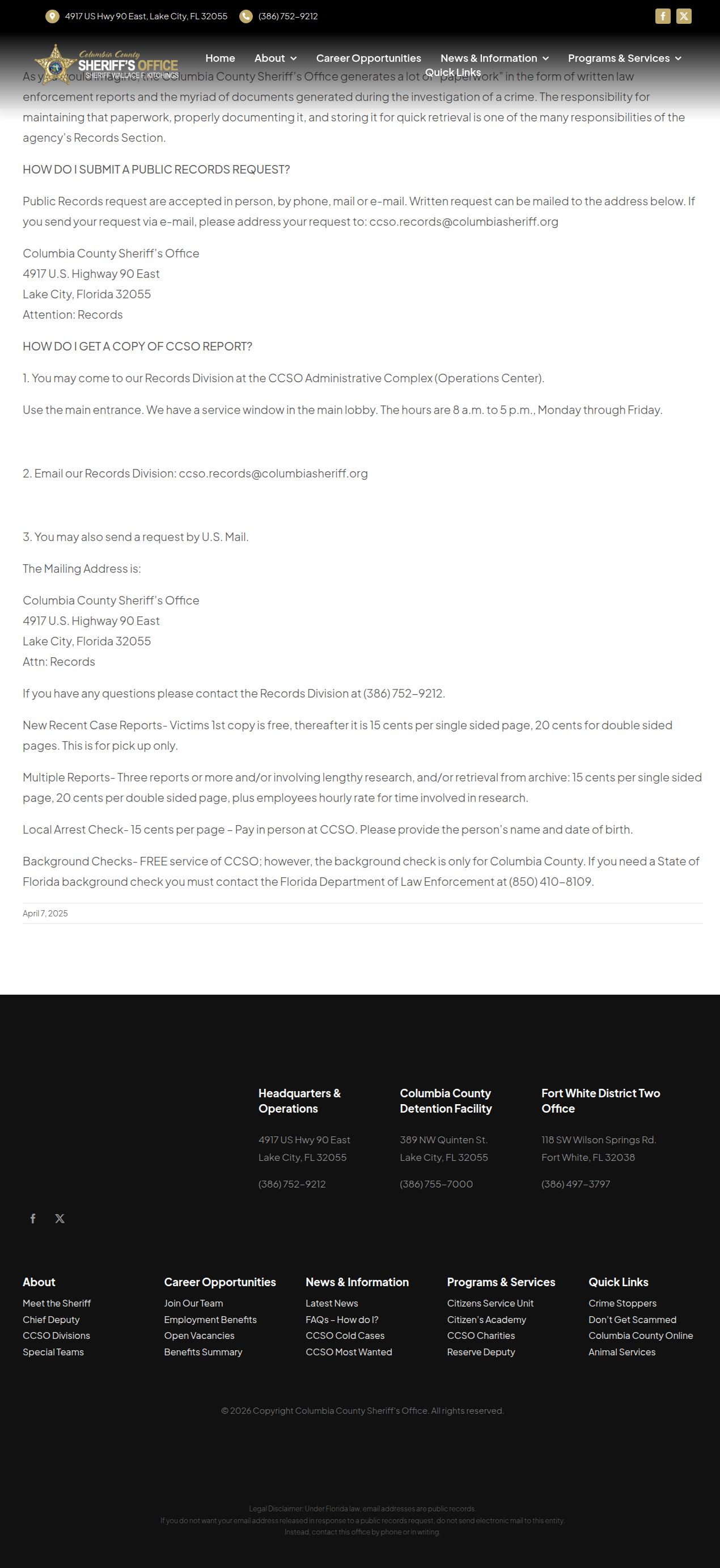
This request channel is the stable substitute for a three-day feed that does not exist online.
Columbia County 72-Hour Record Fields
The GS2 record series offers a useful starting field set. It says a Commitment and Release List may identify people booked or released in a 24-hour period. Combining three daily records or requesting an existing export can cover the chosen 72-hour span, but the custodian decides which record exists and which fields are public.
| Field | Purpose in a three-day check |
|---|---|
| Date and release time | Places the event inside the fixed 72-hour period. |
| Name and booking number | Separates people with similar names and connects the event to the jail file. |
| Charge and court | Points to the correct criminal case and jurisdiction. |
| Bond and returnable date | Provides pretrial context when those fields exist in the record. |
| How released | Identifies bond, court order, sentence completion, transfer, or another recorded basis. |
| Destination or transfer agency | Shows whether another custodian took control after CCSO. |
Florida's schedule also lists race, sex, age, and arresting officer as possible fields. “May contain” is not a promise that every Columbia County list has them. Request what is needed to identify and understand the event. If a field is withheld, ask the office to cite the exemption rather than assume the record does not exist.
Columbia County Weekend Release Checks
A 72-hour interval is useful when a Friday court event, weekend first appearance, or holiday closure breaks the normal rhythm of public access. Columbia County conducts weekend first appearances at the jail. The resulting order may authorize release, but CCSO still performs the custody processing. The docket and jail release time therefore answer different parts of the question.
The Clerk states that online case data is not the official record and is ordinarily updated by 7:00 a.m. with entries from the prior day. A release late in the day can appear in the jail record before related docket activity becomes easy to see online. Conversely, an order may appear before physical release is complete. Neither sequence is proof of an error.
The Clerk search disclaimer shows the update warning directly:
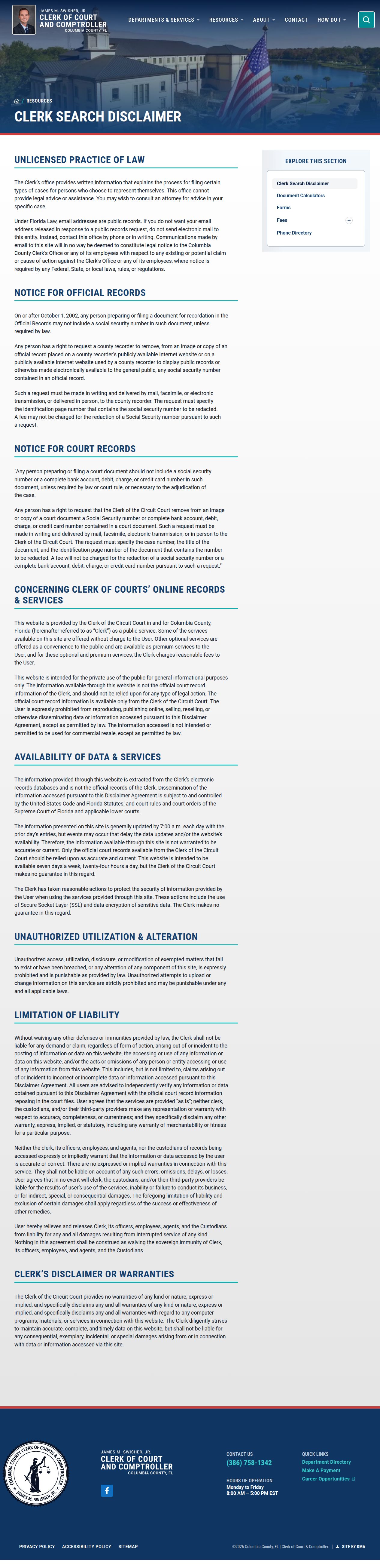
The three-day method allows time for both sources to catch up while preserving the original event window.
Note: Around weekends, compare the court order date, physical release time, and system update time instead of forcing them into one timestamp.
Columbia County Release Data Retention
Florida's GS2 schedule keeps Commitment and Release Lists for at least one anniversary year after release. The underlying inmate-incarceration record copy has the same minimum, subject to release of applicable audits. Jail docket books are permanent. These retention rules are why a record can remain requestable after no public page shows it.
Retention does not create a public web archive. It also does not prove that CCSO calls its list by the GS2 title. The best wording asks for that record series “or the equivalent existing export.” A response may consist of daily records rather than one 72-hour file. That is still useful if each date and time falls within the defined interval.
The incarceration file can add detail that a short list omits. GS2 describes booking cards, commitment papers, transfer orders, work-release records, and receipts for money or property returned at release. Some material may be withheld or redacted under an applicable exemption. Ask for the release documentation first, then request a specific supporting item when the list does not answer who released the person or where custody went next.
The distinction guards against two bad shortcuts: assuming a vanished web row means a vanished record, or taking three screenshots of a current-bookings page and calling them releases. Current custody answers who is held now. Release documentation answers who left, when, why, and where custody went next.
A fixed interval also makes a later follow-up clear. Records staff can search the same dates again if an omitted entry or corrected time becomes relevant.
Verify Columbia County Release Outcomes
Start with the last known custodian. A county jail departure calls for CCSO release documentation and the Clerk case. A transfer to Columbia Correctional Institution, its annex or work camp, Lake City Correctional Facility, or Lake City Bridge Community Release Center calls for FDC's statewide systems. Placement at a community release center remains FDC custody and is not unconditional discharge.
For one person, VINELink can show a participating agency's custody status and status date. No result may reflect spelling, feed delay, participation, or display limits. An FDC Inmate Release Information result is for a person released or scheduled for release from state custody, not for everyone who bonded out of the Columbia County jail. BOP and ICE systems apply only when the local release record identifies a federal or immigration handoff.
A two-source match is strongest. Combine the CCSO physical release line with the court order, or an FDC release detail with its supervision record. The Columbia County 24-hour release process is more direct for a known same-day event, while the home search is suited to a named person whose release period is not known.
Columbia County App Is Not a Feed
The official sheriff app advertises alerts, news, tips, reports, and public interaction. Its store listing does not advertise an inmate roster, recent-release tool, photo gallery, or three-day release view. Current official CCSO pages also do not link to a separate jail app. App access to release records is therefore unverified.
The app may help users follow sheriff news. Those posts are event-based and selective, not a complete record of everyone who left Columbia County Detention Facility. A named records request remains the stable path for a release file, and a fixed 72-hour request remains the best path for a multi-person interval.
Note: App features can change, so confirm any new custody module with CCSO before treating it as an official Columbia County release source.