
Columbia County 24-Hour Release Access
The Columbia County Sheriff's Office does not expose a labeled recent-releases page, released-inmates table, or 24-hour jail release list on its official detention and FAQ pages. Its Detention Facility page explains that Booking handles release and Classification processes court dispositions, release documents, sentence terms, and transfer packets. It does not show a public list of names. There is therefore no official feed URL, web update cycle, or display-retention period to cite.
The practical same-day route begins with the jail, not an unofficial roster mirror. Call Columbia County Detention Facility for immediate status context, then ask CCSO Records for the release line or inmate-incarceration file. Check the Columbia County Clerk docket for the court order that led to release. Use VINELink for a specific person's status or alert. Use the Florida Department of Corrections release search only when the person entered state custody, since that database is not a county bond-out list.
Check Columbia County Releases Today
A focused sequence gives each office a question it can answer. It also keeps a county release separate from a state-prison discharge. For one named person, the broader Columbia County released-inmate search path explains how to reconcile agencies and records.
- Call Columbia County Detention Facility at (386) 755-7000. Ask whether the person remains in CCSO custody and, if not, whether staff can identify a release or transfer.
- Contact CCSO Records at (386) 752-9212 or ccso.records@columbiasheriff.org. Give the booked name, birth date if known, booking or case number, and the exact start and end time.
- Search the Columbia County Clerk court records for a bond, dismissal, sentence, time-served credit, probation, commitment, or later hold.
- Check Florida VINE for that person and reporting agency. Treat a release alert as a prompt to verify, not as the jail's final release record.
- If the jail record says transfer to FDC, switch to the official FDC population and release searches. A transfer ends CCSO custody without putting the person back in the community.
Records staff can identify an existing release log or export, but Florida law does not require the office to create a new analysis. A precise interval makes the request easier to locate and may reduce research time. The CCSO page states that its Records office accepts requests in person, by telephone, mail, or email.
The records office is at 4917 US Highway 90 East and lists weekday hours from 8 a.m. to 5 p.m. Published copy charges are 15 cents for a single-sided page and 20 cents for a double-sided page, with possible labor charges for extensive retrieval. Those terms apply to CCSO records, not Clerk copies. State the preferred format and ask for an estimate if the request could involve many records.
For a same-day question, the detention status call and written record request serve different needs. The call may clarify whether custody continues right now. The written release line supplies a durable agency record with the booked identity, event time, and disposition. Preserve the response alongside the case number so it can be matched to the right court file.
Note: Ask for the physical release time and release type, since the court docket records legal authority rather than the jail-door event.
Columbia County Release Record Fields
No verified CCSO web feed supplies a fixed online field set. Instead, request the fields that distinguish identity, timing, legal authority, and destination. Florida's records schedule defines a statewide Commitment and Release List category, but that title does not prove CCSO uses the same label.
| Requested field | What it can establish |
|---|---|
| Booked name and booking number | Connects the release entry to the correct jail event. |
| Booking date and release date/time | Shows whether the event falls inside the chosen 24-hour interval. |
| Release type or authority | Separates bond, court order, time served, sentence completion, or another basis. |
| Charge and case number | Links the jail event to the correct Clerk docket. |
| Bond information | Shows terms tied to a pretrial release when part of the record. |
| Destination or transfer agency | Distinguishes community release from transfer to FDC or another custodian. |
| Property and money receipt | May document items returned when the person left. |
A useful request begins, “For releases from Columbia County Detention Facility between the stated start date and time and the stated end date and time, provide the existing release log or list showing the booked name, booking number, booking and release times, release type, case number, and transfer destination if public.” Ask for a booking photo separately if it is needed, and ask the custodian to identify any exemption applied to a withheld field.
Columbia County Same-Day Bond Release
A quick Columbia County release may follow the Third Judicial Circuit's pre-first-appearance bond schedule. Administrative Order 2026-001 applies only before the next scheduled first appearance. It sets a separate bond for each charge and does not override a bond already set by a judge. Jail and pretrial personnel have discretion within the order, and the judge keeps authority over the individual case.
The order gives context, not proof that the person left. Payment, other charges, holds, identity checks, court instructions, and jail processing can still affect the event. The CCSO release record supplies the release time. The Clerk docket supplies the bond order and later case activity.
The official order shows both its scope and limits:
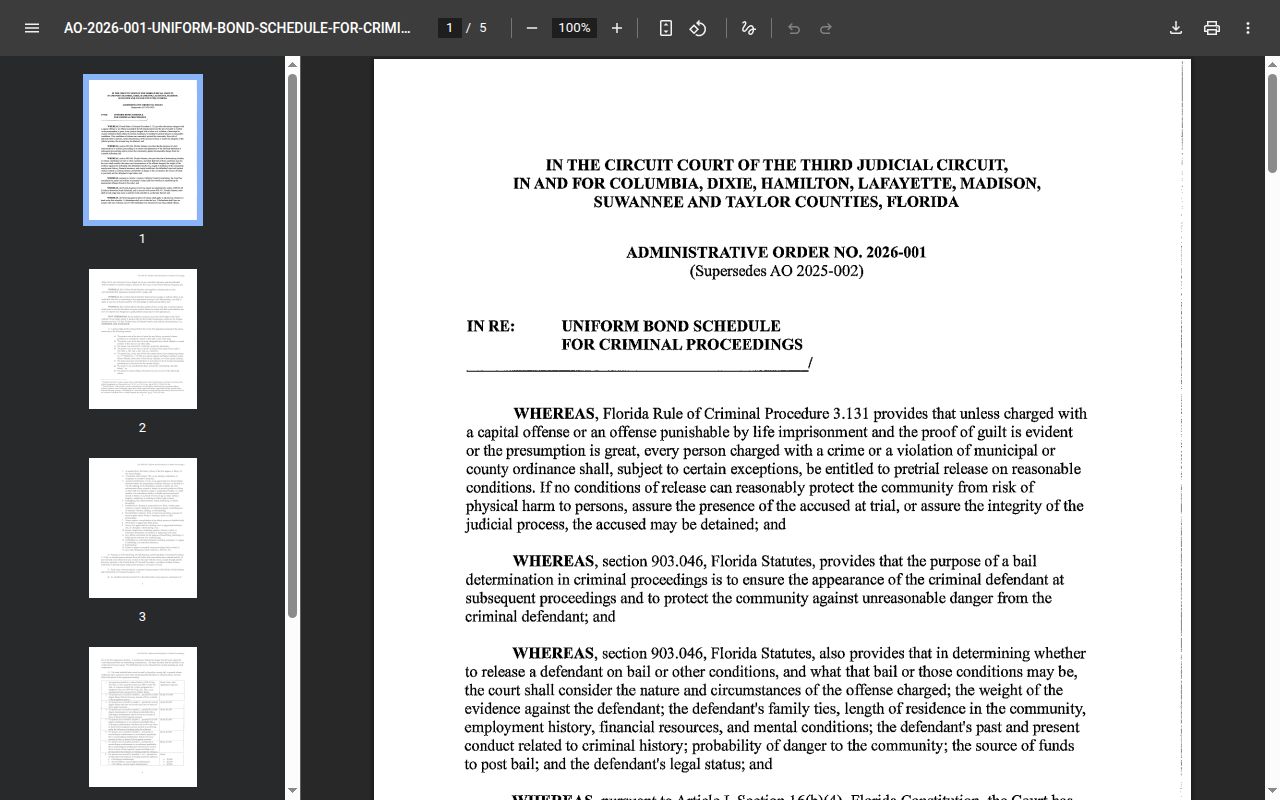
This source helps explain a same-day bond-out without turning a schedule into a promise of release.
Columbia County Release List Retention
Website visibility and government retention are different. Florida's General Records Schedule GS2 defines Commitment and Release Lists as lists of people booked or released during a 24-hour period. It says such a record may include date, booking number, name, race, sex, age, charge, court, arresting officer, bond, how released, and returnable date. The listed minimum retention is one anniversary year after release.
That schedule supports a narrow records request even though Columbia County has no public feed. It does not compel CCSO to post the list online, use the exact record-series title, or show each listed field. Inmate-incarceration records can include booking cards, commitment papers, transfer orders, work-release papers, and receipts for money or property returned at release. Jail docket books are a separate permanent record category.
The minimum period runs from release, not from the day someone happens to search the web. Applicable audit requirements can affect destruction timing. Exempt material can also be redacted from a copy even while the nonexempt record remains available. Medical information, juvenile information, and protected victim-location details are examples of material that may require special handling.
Note: A release list may be retained after it disappears from public view, so ask Records instead of treating web absence as deletion.
Columbia County Sheriff App Limits
The official Columbia County Sheriff mobile app is a real agency channel, but its public listing advertises news, tips, reports, alerts, and agency interaction. It does not advertise a jail roster, inmate lookup, recent-release table, booking-photo gallery, or 24-hour release module. It should not be cited as a release feed unless the agency later adds and documents that feature.
The official app listing records what the sheriff currently presents to users:
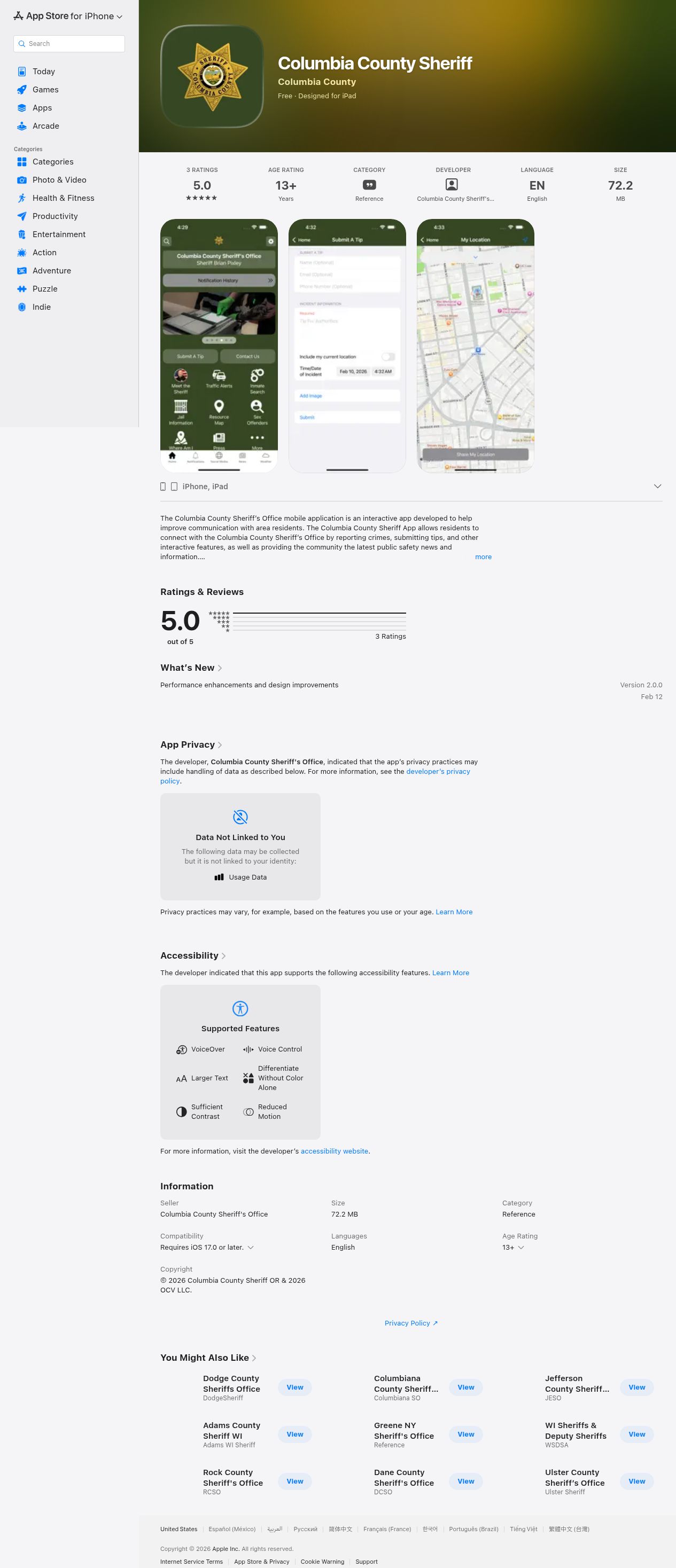
The app remains useful for agency news and alerts. Those posts are episodic, however, and cannot replace a complete Columbia County release record.
Columbia County Release or Transfer
“Released from CCSO” can describe several outcomes. Bond, recognizance, dismissal, time served, sentence completion, or another court order may return a person to the community. A transfer to FDC, another county, the U.S. Marshals, or immigration authorities ends county custody but continues confinement elsewhere. Death is also a custody-ending event, not a community release.
Check the destination field before drawing a conclusion. A person still held at Columbia County Detention Facility belongs in current-status verification. Someone transferred to an FDC prison belongs in the state population database. A completed state release belongs in FDC's Inmate Release Information Search, which refreshes nightly. The Columbia County 72-hour release list process is better when the exact day is uncertain or the interval crosses a weekend.
The Columbia County Clerk record can explain the legal event after a short jail stay. Felony matters proceed in Circuit Court, while misdemeanors and criminal traffic proceed in County Court. Online entries are unofficial and normally reflect prior-day activity by the stated morning update. Request an official copy when the order itself matters, and do not replace the CCSO release time with the Clerk's filing time.